NiTi rotary files + supplier evaluation + B2B sourcing
A practical guide for dental distributors and OEM brands to compare NiTi rotary file suppliers, evaluate samples, verify quality, and select a reliable long-term supply partner.
How to Choose a Reliable NiTi Rotary File Supplier for Dental Distributors and OEM Brands
Choosing a NiTi rotary file supplier is not simply a matter of comparing product prices or selecting the file with the most impressive technical claim.
For dental distributors, importers, and private-label brands, the supplier must be able to provide more than a functional product. The buyer needs confidence that the agreed specification can be reproduced, quality can be controlled, documentation can support the target market, packaging can be managed, and future orders can remain commercially viable.
This becomes particularly important when a buyer is developing a private-label NiTi rotary file line. The first sample may look acceptable, but the real test is whether the supplier can turn that approved sample into a consistent commercial product across repeated production batches.
A practical supplier-selection process can therefore be viewed as:
Product Requirements → Supplier Evaluation → Specification → Samples → Approval → Production Control → Repeat Supply
This guide explains what B2B buyers should evaluate at each stage and how to reduce technical, quality, and commercial risks when sourcing NiTi rotary files.
What Makes a NiTi Rotary File Supplier Reliable?
A reliable supplier should not be evaluated only by whether it can supply NiTi rotary files.
For a B2B buyer, reliability is the combination of several capabilities:
- Clearly defined product specifications
- Controlled material and processing
- Consistent manufacturing precision
- Appropriate mechanical performance
- Documented quality control
- Batch traceability
- Relevant product and regulatory documentation
- Practical MOQ and lead times
- OEM and private-label capability
- Effective technical communication
- Repeat-order consistency
- Controlled change management
This distinction is important because a supplier can produce a good sample without necessarily being capable of maintaining the same product specification over long-term commercial production.
For distributors and OEM brands, the objective is therefore not to find the supplier with the highest advertised performance.
The objective is to find a supplier capable of delivering the right product, to the right specification, with acceptable quality and supply-chain risk.
1. Start With the Product, Not the Supplier
Before comparing suppliers, define what you actually need to purchase.
A request such as:
“We need Gold NiTi rotary files.”
is not a sufficiently precise sourcing requirement.
The supplier still needs to understand the intended product configuration.
Depending on the project, the initial requirement may include:
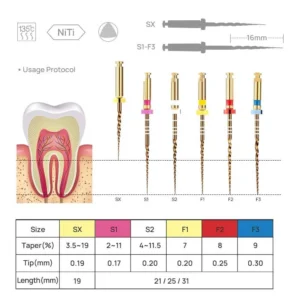
- File system or product type
- Individual file types
- File sequence
- Sizes
- Tapers
- Working lengths
- Tip configuration
- Cross-sectional geometry
- Flute design
- Heat-treatment category
- Continuous rotation or reciprocating motion
- Packaging quantity
- Private-label requirements
- Target market
- Expected order volume
This distinction becomes especially important when several suppliers offer products that appear similar.
A clearly defined requirement gives every supplier the same reference point and makes subsequent sample comparison much more meaningful.
For an OEM project, the buyer should also distinguish between the specification of the complete system and the specification of each individual file.
A multi-file system may contain instruments with different sizes, tapers, geometries, and intended functions. These characteristics should not be treated as one generic product specification.
2. Understand the Mechanical Performance of the File
Mechanical performance is one of the most important areas to evaluate when sourcing NiTi rotary files.
However, performance should not be reduced to a single number such as “maximum cyclic fatigue” or “high torsional resistance.”
The mechanical behavior of a NiTi instrument is influenced by interacting variables including:
- Alloy condition
- Thermomechanical treatment
- Cross-sectional geometry
- Diameter
- Taper
- Core dimensions
- Flute design
- Surface condition
- Manufacturing consistency
- Operating conditions
This means that improving one characteristic may involve trade-offs with another.
A highly flexible design may behave differently under torsional loading from a design with greater core mass. A more aggressive cutting geometry may behave differently from a design intended to reduce engagement.
The correct question is therefore not:
“Which file has the best mechanical property?”
It is:
“Does this combination of mechanical characteristics fit the intended product and clinical positioning?”
Cyclic Fatigue
Cyclic fatigue refers to damage accumulation when a rotating NiTi instrument is repeatedly subjected to tensile and compressive stresses, particularly when operating through a curved path.
When comparing cyclic-fatigue claims, buyers should examine the testing methodology rather than relying on the headline number.
Relevant variables may include:
- File diameter and taper
- Cross-sectional geometry
- Curvature radius
- Curvature angle
- Rotation speed
- Temperature
- Artificial canal or testing medium
- Lubrication
- Testing apparatus
- Failure definition
- Number of samples
Temperature is particularly relevant for heat-treated NiTi instruments because their mechanical behavior can change with temperature.
A reported percentage improvement therefore has limited meaning unless the buyer understands how the result was obtained.
The useful sourcing question is:
Under what conditions was this performance demonstrated, and are those conditions relevant to the intended application?
Torsional Resistance
Torsional failure can occur when part of a file becomes constrained or binds while the rotating portion continues to receive torque.
Torsional behavior can be affected by:
- Material condition
- Cross-sectional geometry
- Core dimensions
- Diameter
- Taper
- Manufacturing characteristics
A larger cross-sectional area may provide greater resistance to torsional loading, but greater material volume can also influence flexibility.
This is why claims such as “stronger cross-section” should not automatically be interpreted as meaning “better overall file.”
When reviewing torsional data, buyers should identify:
- File size
- Taper
- Cross-sectional design
- Torque measurement method
- Rotational conditions
- Failure criteria
- Sample size
- Test methodology
Flexibility
Flexibility describes how readily an instrument bends under a given load.
It is influenced by material properties, phase behavior, geometry, dimensions, taper, and heat treatment.
Two files may both be marketed as “highly flexible” while exhibiting substantially different mechanical behavior.
For B2B sourcing, flexibility should therefore be treated as a product characteristic rather than a marketing adjective.
The relevant question is:
Is the flexibility appropriate for the intended file design and clinical positioning?
Cutting Efficiency and Debris Transportation
Cutting behavior depends on the interaction between:
- Cutting-edge geometry
- Cross-sectional design
- Rake characteristics
- Flute configuration
- Pitch
- Helical characteristics
- File dimensions
- Material condition
- Rotational or reciprocating motion
- Operating parameters
Similarly, debris transportation is influenced by multiple aspects of file geometry and movement.
Therefore, claims such as:
“Faster cutting”
or:
“Superior debris removal”
should be supported by a defined evaluation method rather than treated as universal performance characteristics.
For B2B buyers, mechanical performance should ultimately be viewed as a balance of properties, not a ranking of isolated numbers.
3. Evaluate the Material and Heat Treatment
NiTi material and thermomechanical processing can significantly influence instrument behavior.
When a supplier describes a product as:
- Gold
- Blue
- Heat Treated
- Controlled Memory
- Highly Flexible
the buyer should determine what these commercial descriptions actually represent.
Useful questions include:
- What NiTi material characteristics are specified?
- What thermomechanical treatment is applied?
- Are material characteristics controlled between batches?
- Are relevant transformation characteristics available?
- Is the same material specification used for the approved sample and mass production?
- What happens if the material source or processing changes?
The buyer does not necessarily need disclosure of proprietary manufacturing parameters.
However, characteristics that are critical to the approved product should be identifiable and controlled.
This is particularly important for OEM projects.
If a supplier changes a material source or processing approach after sample approval without evaluating the effect on the product, the commercial product may no longer be equivalent to the approved reference.
4. Evaluate Manufacturing Precision and Dimensional Consistency
NiTi rotary files are precision instruments.
Critical dimensions can include:
- Tip diameter
- Taper
- Working length
- Overall length
- Tip configuration
- Cross-sectional geometry
- Flute configuration
- Other product-specific dimensions
The important question is not whether a supplier claims to have “high precision.”
The better question is:
How are critical characteristics measured and controlled?
Ask the supplier:
- Which dimensions are considered critical?
- What inspection equipment is used?
- How frequently are measurements performed?
- Are inspection records maintained?
- What happens when a result falls outside the specification?
- Can inspection data be provided for samples or production batches?
For an OEM product, the approved sample should eventually be translated into a defined specification.
Otherwise, the buyer may have difficulty determining whether a future batch is actually equivalent to the original product.
5. Evaluate Quality Control and Traceability
The first shipment does not prove long-term consistency.
A distributor needs to know whether the supplier can maintain the approved product across repeated production.
Relevant quality records may include:
- Raw-material identification
- Production batch information
- Dimensional inspection
- Finished-product inspection
- Packaging inspection
- Non-conformance records
- Corrective-action records
- Shipment records
Batch traceability is particularly valuable when a product is distributed across multiple markets.
If a quality issue appears several months after shipment, the buyer should be able to identify the relevant production batch and investigate the problem.
The practical principle is simple:
Approved Product → Identifiable Production Batch → Inspection Record → Shipment
This creates a much stronger quality-control structure than treating every order as an independent transaction
6. Review Mechanical Test Data Properly
Mechanical testing can provide useful evidence, but test results must always be interpreted within their methodology.
Potential evaluations include:
- Cyclic fatigue
- Torsional behavior
- Flexibility
- Cutting behavior
- Deformation
- Fracture characteristics
When a supplier provides test data, ask:
- What exact product was tested?
- What file size and taper were used?
- What geometry was tested?
- What material condition was used?
- At what temperature?
- What rotational or reciprocating parameters were used?
- What fixture or canal geometry was used?
- How many samples were tested?
- What was the failure criterion?
- What was the comparison baseline?
A statement such as:
“50% higher cyclic fatigue resistance”
is not sufficient by itself.
The buyer needs to know what was compared, how it was tested, and whether the result is relevant to the commercial product.
This is particularly important when comparing different suppliers.
Comparable products + comparable test conditions = more meaningful comparison.
7. Define the OEM Product Specification Before Approval
For private-label projects, product specification control is the foundation of the entire supply relationship.
Terms such as “Gold rotary file” or “flexible NiTi file” may be useful during early discussions, but they are not production specifications.
A practical OEM specification should define the agreed product in enough detail that both buyer and supplier understand what must be reproduced.
Product Configuration
Define:
- Product name
- Product model
- File sequence
- Individual file types
- Sizes
- Tapers
- Working lengths
- Intended operating mode
- Product quantity
Dimensional Requirements
Where applicable, define:
- Tip diameter
- Taper
- Working length
- Overall length
- Tip geometry
- Cross-sectional geometry
- Flute characteristics
- Other critical dimensions
Recognized standards may be used where applicable.
For example, ISO 3630-1 is relevant to applicable endodontic instruments and addresses areas including dimensions, designation, color coding, packaging, identification, and certain testing requirements. Buyers should confirm the current applicable edition and scope for the specific product and market rather than assuming that one standard covers every commercial or regulatory requirement.
Material and Processing
Define or confirm:
- Material characteristics
- Heat-treatment category
- Relevant transformation characteristics where applicable
- Surface condition
- Manufacturing finish
- Critical processing requirements
The level of detail should match the project’s technical requirements.
The goal is not to force disclosure of proprietary manufacturing technology.
The goal is to identify characteristics that are critical to product equivalence.
Packaging and Branding
Packaging should also become part of the approved specification.
It may include:
- Brand name
- Logo
- Product name
- File markings
- Size and taper information
- Quantity per box
- Individual packaging
- Outer box
- Carton configuration
- Lot or batch identification
- Language requirements
- Market-specific labeling
The buyer should clarify whether the packaging is supplied directly by the buyer or coordinated by the supplier.
Artwork should ideally be approved before mass production.
8. Understand the Difference Between Private Label, OEM and New Product Development
These terms should not be treated as interchangeable.
Private Label
The buyer selects an existing product and sells it under its own brand and packaging.
OEM Customization
The buyer requests defined changes to an existing product, such as specifications, packaging, labeling, markings, or product configuration.
New Product Development
The project involves substantially new specifications and may require additional engineering, tooling, testing, validation, and regulatory work.
For many dental distributors, private label or controlled OEM customization is a more practical starting point than developing an entirely new NiTi file system.
Before requesting an “OEM NiTi rotary file,” buyers should clarify which of these models they actually require.
9. Evaluate OEM Packaging and MOQ Separately
MOQ is one of the most important commercial considerations in private-label sourcing.
A supplier may offer a relatively low MOQ for a standard product while requiring a substantially larger quantity for customized packaging.
Additional costs can arise from:
- Packaging setup
- Artwork preparation
- Printing
- Tooling
- Production setup
- Inspection
- Inventory commitments
Therefore, buyers should distinguish between:
Product MOQ
and
Customized Packaging MOQ
A practical quotation should clarify:
- Sample quantity
- Sample cost
- Sample lead time
- Standard-product MOQ
- OEM-product MOQ
- Packaging MOQ
- Repeat-order MOQ
- Pricing at different volume levels
For a distributor entering a new market, a realistic path from sample to small trial order to repeat production can materially reduce inventory risk.
10. Test Supplier Samples Systematically
A supplier sample should be evaluated systematically against the agreed specification.
It should be evaluated against the agreed specification.
A practical sequence is:
Specification → Samples → Inspection → Performance Evaluation → Comparison → Approval
Dimensional Inspection
Depending on the product, inspect:
- Tip dimensions
- Taper
- Working length
- Overall dimensions
- Geometry
- Tip configuration
- Flute characteristics
If several suppliers are being compared, apply the same inspection method to every supplier.
Visual and Surface Inspection
Review:
- Surface appearance
- Grinding marks
- Burrs
- Tip appearance
- Flute consistency
- Surface contamination
- Corrosion or discoloration
- Product markings
- Packaging integrity
Visual inspection does not replace mechanical testing.
However, obvious manufacturing inconsistencies may indicate that further investigation is necessary.
Multiple Samples
One instrument from each supplier is rarely sufficient to evaluate production consistency.
Where practical, inspect multiple samples from each supplier.
The objective is not to perform unnecessarily expensive testing.
It is to determine whether the supplier can reproduce the relevant characteristics across individual instruments.
11. Compare Supplier Samples Under Equivalent Conditions
When comparing Supplier A and Supplier B, the products should be as comparable as possible.
A useful principle is:
Same Size + Same Taper + Similar Configuration + Equivalent Test Conditions
Comparing a smaller file from one supplier with a larger file from another can produce misleading conclusions.
The same problem occurs with mechanical testing.
If one supplier reports cyclic-fatigue results at room temperature while another uses a different temperature, the numerical results should not automatically be placed side by side.
The objective is not to find the largest performance number.
It is to determine which supplier provides the most relevant evidence for the product being considered.
12. Use Sample Approval as the Bridge to Production
For an OEM project, it is useful to distinguish between:
Sample for Evaluation
and
Approved Production Reference
A sample sent for evaluation does not automatically become the final production standard.
Once the buyer approves a product, the approved version should be documented.
An approval record may identify:
- Product model
- File size
- Taper
- Working length
- Packaging version
- Product specification
- Inspection results
- Approved photographs or drawings
- Sample date
- Approval status
The approved product then becomes the reference for future production.
This creates the link:
Specification → Approved Sample → Production → Inspection → Repeat Order
Without this link, an OEM program can become difficult to control as order volume increases.
13. Evaluate Change Control
Long-term supply requires control not only over today’s production, but also over future changes.
Potential changes may involve:
- Raw-material source
- Material specification
- Heat treatment
- Grinding process
- Production equipment
- Production facility
- Packaging material
- Critical sub-suppliers
- Inspection methods
Not every change will materially affect product performance.
However, significant changes should be identified, evaluated, and communicated according to an agreed process.
This matters because an OEM brand may already have invested in:
- Packaging
- Marketing
- Customer testing
- Distributor training
- Inventory
- Product registration
- Market approvals
An unexpected change to the underlying product can therefore create consequences far beyond manufacturing.
14. Evaluate Documentation and Regulatory Requirements
Documentation should be reviewed according to the target market and actual supply arrangement.
Potential documents may include:
- Product specifications
- Quality-management certificates
- Test reports
- Material information
- Inspection records
- Packaging information
- Batch information
- Regulatory documentation where applicable
- Export documents
A certificate should not automatically be treated as proof that every product or every batch is superior.
For example, ISO 13485 certification provides information about an organization’s quality-management system within its stated scope. It does not replace product-specific evaluation.
Buyers should also verify:
- Legal entity
- Manufacturer identity
- Product scope
- Certificate validity
- Applicable market
- Relationship between commercial supplier and actual manufacturer
This is particularly important when sourcing through a trading company or intermediary.
The commercial supplier and manufacturing facility may be different entities.
That arrangement is not necessarily problematic, but the relationship should be transparent and the relevant responsibilities should be clear.
15. Evaluate Production Capacity and Lead Time
A supplier should not be judged simply by its claim of having a “large factory.”
The more relevant question is whether it can support the buyer’s actual order pattern.
Consider:
- Sample lead time
- Production lead time
- Packaging lead time
- MOQ
- Monthly capacity
- Raw-material availability
- Peak-season capacity
- Repeat-order capability
- Communication during production
It is also useful to distinguish between quoted lead time and actual delivery performance.
A supplier promising five-day production is not necessarily more reliable than one quoting ten days if the first supplier repeatedly misses its commitment.
For distributors, predictability is often more valuable than an attractive but unrealistic lead-time promise.
16. Evaluate the Supplier for Long-Term Distribution
The supplier decision changes once the product becomes a regular commercial line.
For the first sample order, buyers may focus primarily on:
Price + Product Quality
For long-term distribution, the evaluation becomes broader:
Product Fit → Quality Consistency → Supply Reliability → Commercial Viability → OEM Support → Documentation → Communication
Product-Market Fit
The right file depends on:
- Target customer segment
- Local clinical preferences
- Competitor positioning
- Price level
- Product configuration
- Packaging requirements
- Regulatory environment
A premium-positioned OEM brand may require a different product strategy from a distributor serving a price-sensitive market.
Inventory Risk
A low unit price does not automatically create a better business opportunity.
Consider:
- MOQ
- Unit price
- Demand forecast
- Packaging requirements
- Reorder frequency
- Storage costs
- Working capital
- Shelf life where applicable
A practical progression may be:
Sample → Small Trial Order → Market Validation → Repeat Order → Larger Volume
This allows the buyer to validate demand before committing significant inventory.
Total Landed Cost
The real sourcing cost may include:
- Product cost
- Packaging
- Sampling
- Inspection
- Documentation
- Freight
- Import-related costs
- Rework
- Defective products
- Delays
- Communication overhead
- Inventory carrying costs
The lowest quoted unit price may therefore not represent the lowest total commercial cost.
17. Consider Supply-Chain Risk
For important product lines, buyers should also consider dependence on a single supplier.
Potential risks include:
- Production interruption
- Extended lead times
- Product discontinuation
- Uncontrolled specification changes
- Commercial-term changes
- Communication problems
This does not mean that every distributor needs two active suppliers for every SKU.
However, the buyer should understand the concentration risk and determine whether backup sourcing is appropriate.
A well-defined product specification also makes second-source qualification easier if the need arises.
18. A Practical NiTi Rotary File Supplier Evaluation Scorecard
When comparing multiple suppliers, avoid relying on quotations alone.
A standardized scorecard can make the decision more objective.
| Evaluation Area | Suggested Weight | Key Question |
|---|---|---|
| Product specification | 15% | Is the product clearly defined? |
| Manufacturing consistency | 15% | Can the approved product be reproduced? |
| Quality control | 15% | Are critical characteristics controlled? |
| Technical documentation | 10% | Is relevant technical information available? |
| Mechanical testing | 10% | Are performance claims appropriately supported? |
| OEM capability | 10% | Can private-label requirements be managed? |
| MOQ & commercial flexibility | 10% | Does the commercial model fit the business? |
| Lead time & supply capability | 10% | Can replenishment be planned reliably? |
| Communication | 5% | Can requirements be coordinated effectively? |
| Total | 100% |
For a long-term distributor, consistency and replenishment may deserve greater weight.
For an OEM brand, specification control, packaging, documentation, and change management may be more important.
The scorecard is not intended to identify a universal winner.
It is intended to prevent one attractive characteristic—usually price—from dominating the entire supplier decision.
19. What Should Disqualify a Supplier?
Not every weakness requires automatic rejection.
However, several issues should trigger additional investigation before a significant order is placed.
These may include:
- Unclear product specifications
- Inconsistent explanations of material or processing
- Test results without identifiable methodology
- Inability to explain the actual manufacturing arrangement
- Documentation that does not match the commercial supplier
- Significant differences between approved samples and production products
- Unclear product or packaging MOQ
- Unexplained changes between orders
- No identifiable batch information
- Reluctance to confirm critical specifications in writing
- Repeatedly unrealistic lead-time commitments
- Inability to reproduce approved packaging or product configuration
The purpose is not to find a supplier with zero risk.
It is to identify risks before they become expensive commercial problems.
20. A Supplier Is More Than a Product Source
There is an important difference between a product supplier and a reliable B2B supply partner.
A product supplier answers:
“Can you supply this file?”
A reliable B2B partner should be able to answer:
What exactly is the specification?
How is it controlled?
Can the approved sample be reproduced?
What documentation is available?
How are changes managed?
How are quality problems handled?
Can the product be supplied consistently as order volume increases?
For distributors and OEM brands, these questions can matter more than a small difference in unit price.
A low purchase price can lose its advantage quickly if the buyer repeatedly encounters:
- Inconsistent dimensions
- Packaging errors
- Missing documents
- Production delays
- Unexpected product changes
- Difficult communication
- Repeat-order inconsistencies
21. How AMEXORS Supports B2B NiTi Rotary File Sourcing
For international buyers, NiTi rotary file sourcing can involve several separate parties and decisions:
Product Selection → Supplier Coordination → Specification → Sampling → Quality Review → Packaging → Documentation → Production → Export
AMEXORS supports this process as a B2B dental product sourcing partner, coordinating with appropriate product suppliers and manufacturers according to the buyer’s requirements.
The objective is not to present one standard file as the answer for every market.
It is to help buyers identify a suitable product configuration, clarify the commercial and technical requirements, coordinate supplier communication, and move from initial inquiry toward a workable supply arrangement.
Product Matching and Specification Confirmation
Some buyers already know the exact product they need.
Others may have only:
- A competitor reference
- A target price
- A target market
- A preferred packaging concept
- A desired product positioning
AMEXORS can help translate these requirements into a clearer sourcing brief covering areas such as:
- File type
- Sizes and tapers
- Working lengths
- File sequence
- Heat-treatment category
- Geometry
- Packaging quantity
- Private-label requirements
- Target market
- Expected order volume
This provides a more structured basis for supplier comparison and sample evaluation.
OEM and Private-Label Coordination
For distributors developing their own dental brand, the physical file is only one part of the project.
AMEXORS can coordinate requirements involving:
- Private-label packaging
- Logo application
- Product naming
- Product markings
- Packaging artwork
- Product codes
- Box quantity
- Label information
- Sample packaging
The exact customization available depends on the selected supplier and project requirements.
Before mass production, product and packaging specifications can be reviewed against the approved version.
Sample Coordination
AMEXORS can coordinate supplier samples according to the agreed requirements.
For buyers evaluating multiple options, supplier information can be organized around:
- Product configuration
- Dimensions
- Visual quality
- Packaging
- Documentation
- MOQ
- Pricing
- Lead time
- OEM flexibility
Where independent technical testing is required, the buyer should use an appropriate laboratory or evaluation method according to its own quality and regulatory requirements.
Supplier information and sourcing coordination should support technical evaluation rather than replace independent validation where such validation is required.
Documentation and Quality Coordination
Depending on the target market and product arrangement, buyers may require different technical, quality, and regulatory documents.
AMEXORS can coordinate the collection and organization of available supplier documentation according to the project requirements.
Where pre-shipment inspection is required, inspection arrangements can also be coordinated before dispatch.
The inspection scope should be agreed before production or shipment.
Production and Export Coordination
Once a product has been approved, the process continues through:
Production → Inspection → Packing → Export → Shipment
AMEXORS can coordinate relevant information involving:
- Production schedules
- Packing information
- Export documentation
- Freight arrangements
- Logistics communication
- Shipment tracking
The appropriate shipping method and trade terms depend on the destination, order size, product requirements, and buyer’s import arrangements.
The objective is to reduce coordination complexity by providing a more centralized B2B communication channel.
22. Why Use a B2B Sourcing Partner?
Experienced procurement teams with established supplier networks may prefer to work directly with manufacturers.
For distributors entering a new product category, however, direct sourcing can create additional coordination work.
The buyer may need to independently manage:
Supplier Search → Product Comparison → Samples → Specification → Packaging → Documentation → Inspection → Shipping
A sourcing partner can consolidate part of this communication and coordinate different stages through one commercial relationship.
The value is therefore not simply access to a product.
It is the reduction of supplier-search and coordination complexity.
At the same time, buyers should understand exactly what the sourcing partner is responsible for and which technical, regulatory, and quality responsibilities remain with the buyer.
23. A Practical Process for New B2B Buyers
A new distributor or OEM brand does not necessarily need to begin with a large production order.
A controlled sourcing process can follow:
Step 1: Define the Product
Specify the required file type, sizes, tapers, lengths, packaging, and target market.
Step 2: Define the Commercial Requirement
Establish expected volume, target price range, MOQ preference, packaging requirements, and private-label needs.
Step 3: Screen Suppliers
Compare product specifications, manufacturing information, documentation, MOQ, lead time, and OEM capability.
Step 4: Request Samples
Obtain samples based on the same defined requirements.
Step 5: Inspect and Compare
Evaluate dimensions, geometry, surface condition, packaging, documentation, and relevant performance information.
Step 6: Confirm the Specification
Translate the approved product into a documented product specification.
Step 7: Approve the Production Reference
Record the approved sample, product version, packaging, and relevant requirements.
Step 8: Start With a Controlled Order
Use an initial commercial order appropriate to the market demand and inventory risk.
Step 9: Monitor Production
Where appropriate, review production and inspection information before shipment.
Step 10: Evaluate Repeat Supply
Compare subsequent batches against the approved product and monitor lead time, quality, documentation, and communication.
This staged approach allows the buyer to qualify not only the product, but also the supplier relationship.
24. The Final Supplier Decision
The best NiTi rotary file supplier is not necessarily:
- The supplier with the lowest price
- The supplier with the highest cyclic-fatigue number
- The supplier with the largest factory
- The supplier with the longest product catalog
- The supplier offering the lowest MOQ
The more useful decision framework is:
Product Fit + Specification Control + Quality Evidence + Supplier Capability + Commercial Fit + Long-Term Consistency
For distributors and OEM brands, the final question should be:
Can this supplier turn the approved product into a repeatable commercial product while keeping quality, supply, documentation, and commercial risks manageable?
If the answer is yes, the supplier has the foundation for a long-term B2B relationship.
If the answer depends mainly on a good first sample or an attractive quotation, the supplier has not yet been sufficiently qualified.
FAQ
What should I look for when choosing a NiTi rotary file supplier?
Look beyond unit price. Evaluate product specifications, material and processing, manufacturing consistency, quality control, mechanical test data, documentation, MOQ, lead time, OEM capability, communication, and repeat-order capability.
For technical performance claims, request the testing methodology and conditions rather than relying on isolated marketing numbers.
How do I choose a NiTi rotary file supplier for my distribution business?
Start with your target market and define the required product configuration.
Then compare suppliers based on product fit, sample quality, manufacturing consistency, MOQ, pricing, documentation, lead time, packaging capability, and repeat-order reliability.
The supplier that best fits the long-term distribution model may be more valuable than the supplier offering the lowest initial quotation.
What is the difference between a NiTi rotary file supplier and an OEM supplier?
A standard supplier may provide an established product and packaging configuration.
An OEM supplier may additionally coordinate product specifications, private-label packaging, branding, samples, and defined product customization.
The exact level of OEM capability depends on the supplier and project.
What should I ask a NiTi rotary file supplier before ordering samples?
Ask for:
- Product specifications
- Available sizes and tapers
- Working lengths
- Material or heat-treatment information
- Packaging options
- MOQ
- Sample cost
- Sample lead time
- Production lead time
- Quality documentation
- Private-label options
- Relevant test reports
If the supplier makes mechanical-performance claims, ask for the test conditions and the exact product specification tested.
How can I compare NiTi rotary file samples from different suppliers?
Use the same evaluation criteria for every supplier.
Compare:
- Dimensions
- Geometry
- Surface condition
- Product markings
- Packaging
- Documentation
- Relevant mechanical data
When comparing test results, make sure the products and testing conditions are sufficiently comparable.
Different file sizes, tapers, geometries, temperatures, and test methods can materially affect the results.
Does heat treatment make a NiTi rotary file better?
Heat treatment can significantly change the phase transformation behavior and mechanical properties of NiTi instruments.
However, “heat treated” alone does not establish overall product quality.
Material characteristics, thermomechanical processing, geometry, dimensions, surface condition, and testing methodology should also be considered.
Are Gold and Blue NiTi files different types of NiTi?
“Gold” and “Blue” are commercial designations commonly associated with particular heat-treatment and surface-processing approaches.
They should not be treated as universal material specifications.
Buyers should ask what actual material and thermomechanical characteristics the designation represents.
Is cyclic fatigue resistance enough to determine NiTi file quality?
No.
Cyclic fatigue is only one aspect of mechanical behavior.
Torsional loading, flexibility, geometry, dimensions, surface characteristics, material condition, motion, and operating conditions can also influence instrument behavior.
A supplier should therefore be evaluated using the complete product specification rather than one mechanical-performance number.
Does reciprocating motion always make a NiTi file better?
Not necessarily.
Reciprocating and continuous-rotation systems represent different design and operating approaches.
The relative performance depends on the instrument, motion parameters, geometry, material condition, and testing methodology.
For B2B buyers, the more useful question is which system fits the intended product positioning and target market.
What information should be included in an OEM NiTi rotary file specification?
A practical specification should identify:
- Product configuration
- File sizes and tapers
- Working lengths
- Critical dimensions
- Geometry
- Material characteristics
- Heat-treatment requirements where applicable
- Surface requirements
- Packaging
- Branding
- Labeling
- Quality requirements
- Testing requirements
- Traceability
- Documentation
- Approved sample
- Change-control requirements
The level of detail should be appropriate to the product and market.
What standard applies to endodontic instruments?
ISO 3630-1 is a relevant international standard for applicable endodontic instruments and covers areas including dimensions, designation, color coding, packaging, identification, and certain test requirements.
Buyers should verify the current applicable edition and its scope for the specific product and destination market.
Can AMEXORS provide OEM and private-label NiTi rotary files?
AMEXORS can coordinate NiTi rotary file sourcing with appropriate supplier and manufacturing partners according to the buyer’s product, packaging, quantity, and market requirements.
Depending on the project, this may include product matching, sample coordination, specification confirmation, private-label packaging, documentation coordination, quality-inspection arrangements, production coordination, and international shipment coordination.
The exact OEM capability, MOQ, customization options, and production conditions should be confirmed for each project.
Can I order samples before placing a larger order?
Yes.
A sample-based evaluation is a practical starting point for a new B2B sourcing project.
The buyer can first confirm the product specification, evaluate samples, review packaging and documentation, and then determine an appropriate trial order before committing to larger volumes.
How do I start sourcing NiTi rotary files for my dental distribution business?
Start by providing the basic requirements:
- Target market
- Required file type
- Sizes and tapers
- Working lengths
- Estimated order quantity
- Packaging requirements
- Private-label requirements
- Existing product reference
- Target price range
The sourcing process can then progress through product matching, supplier evaluation, sample coordination, specification confirmation, and controlled trial ordering.
Request NiTi Rotary File Samples and Supplier Information
If you are evaluating NiTi rotary files for distribution, OEM, or private-label development, the most useful starting point is a clear product and commercial requirement.
You can provide:
- Required file system or product type
- Sizes and tapers
- Working lengths
- Target market
- Estimated order quantity
- Packaging requirements
- Private-label requirements
- Existing product reference
- Target price range
- Required documentation
AMEXORS can then coordinate the sourcing process around the defined requirements, from supplier and product matching through samples, specification confirmation, packaging, production coordination, and shipment.