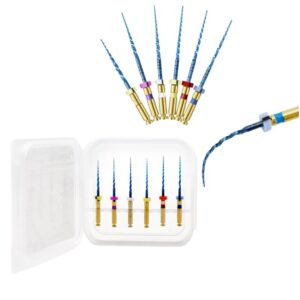
What Is a NiTi Rotary File?
Learn what NiTi rotary files are, why nickel-titanium is used in endodontics, and how file design, taper, cross-section, heat treatment, and kinematics affect performance. This guide helps dental professionals, distributors, and private-label brands understand modern NiTi rotary file systems.

What Is a NiTi Rotary File?
Nickel-titanium (NiTi) rotary files are engine-driven endodontic instruments designed for the mechanical cleaning and shaping of root canals. Their flexibility, elastic behavior, and engineered file geometry allow them to follow curved canal anatomy more effectively than conventional stainless-steel instruments.
Today, NiTi rotary files are available in many different systems, tapers, tip sizes, cross-sectional designs, heat treatments, and motion patterns. Understanding these differences is important for clinicians selecting instruments and for dental distributors and private-label brands evaluating NiTi rotary file systems.
This guide explains what NiTi rotary files are, how they work, why nickel-titanium is used, how file design affects performance, what heat-treated NiTi means, and how modern rotary file systems have evolved.
What Is a NiTi Rotary File?
A NiTi rotary file is an engine-driven endodontic instrument made primarily from nickel-titanium alloy and designed for mechanical root canal preparation.
Unlike conventional hand files, which are manipulated manually, NiTi rotary files are used with an endodontic motor that controls the instrument’s movement according to the requirements of the selected file system.
The term NiTi refers to nickel-titanium, an alloy commonly known as Nitinol. Its distinctive mechanical behavior comes from reversible changes in its crystal structure and allows the material to accommodate substantial deformation while maintaining useful flexibility and elasticity.
NiTi instruments became important in endodontics because their mechanical properties made it possible to prepare curved root canals with less rigidity than conventional stainless-steel instruments. The development of engine-driven NiTi instruments subsequently led to continuous rotary systems, heat-treated alloys, reciprocating systems, and increasingly complex file geometries. citeturn0search1turn0search12
What Is NiTi and Why Is It Used for Endodontic Files?
The main reason nickel-titanium is used for endodontic instruments is its combination of flexibility, elasticity, and shape-memory behavior.
Traditional NiTi instruments used at clinical temperatures are predominantly in the austenitic phase and exhibit superelastic behavior. Depending on the alloy composition and thermomechanical treatment, the material can also contain or transform toward martensite or an intermediate R-phase.
These phase transformations influence the mechanical behavior of the instrument.
In simplified terms:
- Austenite is generally stiffer and more resistant to deformation.
- Martensite is generally more flexible and can accommodate greater deformation.
- R-phase can occur as an intermediate phase during certain transformations.
Modern heat treatments are used to modify these transformation characteristics and adjust the balance between flexibility, strength, and fatigue resistance. citeturn0search2turn0search3
This is why two NiTi rotary files can have very different mechanical properties even when both are made from nickel-titanium.
How Do NiTi Rotary Files Work?
NiTi rotary files work through controlled mechanical movement inside the root canal.
The file is connected to an endodontic motor, which controls parameters such as rotational speed and torque according to the manufacturer’s recommended protocol.
During instrumentation, the cutting edges of the file engage dentin while the flutes provide space for material and debris movement. The geometry of the file determines how it contacts the canal walls and how forces are distributed along the instrument.
The overall objective is to create a controlled canal shape while preserving as much of the original anatomy as possible.
Mechanical instrumentation is only one part of root canal treatment. Contemporary evidence emphasizes that rotary instruments do not contact every portion of the canal wall, making chemical irrigation and other aspects of endodontic treatment essential as well. citeturn0search0
NiTi Rotary Files vs Stainless Steel Hand Files
NiTi rotary files and stainless-steel hand files serve different purposes in endodontic treatment.
| Feature | NiTi Rotary Files | Stainless Steel Hand Files |
|---|---|---|
| Material | Nickel-titanium alloy | Stainless steel |
| Primary movement | Engine-driven | Manual |
| Flexibility | Generally higher | Generally lower, especially in larger sizes |
| Curved canals | Better ability to follow curvature | More susceptible to straightening forces |
| Instrumentation efficiency | Designed for controlled mechanical shaping | More operator-dependent |
| Available geometries | Wide range of tapers and cross-sections | More standardized hand-file designs |
| Main considerations | Fatigue, torsional stress, file design, motor settings | Rigidity, canal transportation, manual technique |
NiTi rotary files did not eliminate the need for stainless-steel hand files. Hand instruments remain useful for tasks such as canal negotiation, scouting, and establishing or maintaining a glide path.
The two types of instruments are therefore better understood as complementary rather than as direct replacements for one another.
What Are the Advantages of NiTi Rotary Files?
Flexibility
NiTi instruments are substantially more flexible than conventional stainless-steel instruments of comparable dimensions. This allows appropriately designed files to follow curved canals more closely during mechanical preparation.
More Controlled Canal Shaping
Engine-driven NiTi systems can provide a consistent sequence of movements and predefined file geometries. This can make canal preparation more standardized compared with entirely manual instrumentation.
Reduced Canal Transportation
A flexible instrument that better follows the original canal curvature can reduce the tendency to straighten the canal during preparation. However, canal transportation depends on many factors, including file geometry, taper, size, alloy properties, instrumentation technique, and canal anatomy.
Efficient Mechanical Preparation
Rotary systems can remove dentin efficiently while creating a planned taper and shape. Different systems use different file sequences and geometries to achieve their intended preparation objectives.
Compatibility With Modern Endodontic Workflows
NiTi rotary systems are widely integrated with torque-controlled endodontic motors and modern instrumentation protocols, making them an important part of contemporary mechanical root canal preparation. citeturn0search1turn0search4
What Are the Limitations of NiTi Rotary Files?
NiTi rotary files are not fracture-proof and should not be considered automatically safer simply because they are flexible.
The main mechanical failure mechanisms include cyclic fatigue and torsional failure.
Cyclic Fatigue
When a rotating file repeatedly passes through a curved section of a canal, the instrument experiences alternating tensile and compressive stresses.
Repeated loading can eventually produce fatigue damage and fracture.
Torsional Failure
Torsional failure occurs when part of the file becomes locked against the canal wall while the motor continues to rotate the instrument.
The instrument can then exceed its torsional limit and fracture.
Other Limitations
Performance can also be affected by:
- Excessive taper or file size
- Complex canal anatomy
- Inadequate glide path preparation
- Excessive apical pressure
- Incorrect motor settings
- Repeated use
- Manufacturing defects or surface imperfections
- Inappropriate file selection
Modern NiTi development therefore focuses not on flexibility alone, but on balancing flexibility, torsional resistance, cyclic fatigue resistance, cutting efficiency, and shaping performance. citeturn0search7turn0search8
How Does NiTi Rotary File Design Affect Performance?
The alloy is only one part of a rotary file.
Two instruments made from similar NiTi alloys can behave differently because of differences in geometry and manufacturing.
Important design parameters include:
- Tip size
- Taper
- Cross-section
- Core diameter
- Cutting edge
- Flute design
- Helix angle
- Pitch
- Tip design
- Surface treatment
These features influence flexibility, cutting efficiency, debris removal, torsional resistance, and the way the instrument interacts with the canal wall. Research reviews consistently identify geometry and manufacturing as major determinants of NiTi instrument performance.
Tip Size
The tip size is generally expressed using ISO sizing.
For example:
- #20 = approximately 0.20 mm tip diameter
- #25 = approximately 0.25 mm tip diameter
- #30 = approximately 0.30 mm tip diameter
A larger tip generally means a larger instrument diameter at the tip and can affect both shaping capability and mechanical loading.
Taper
Taper describes how quickly the diameter of the instrument increases from the tip.
For a constant .06 taper, the diameter increases approximately 0.06 mm for every 1 mm from the tip.
Common examples include:
- .02 taper
- .04 taper
- .06 taper
- Variable taper designs
Taper affects the amount of dentin removed, canal shape, instrument stiffness, and contact between the file and canal walls.
Cross-Section
Cross-sectional geometry is one of the most important differences between NiTi rotary file systems.
Different systems may use:
- Triangular cross-sections
- Rectangular cross-sections
- S-shaped designs
- Convex triangular designs
- Off-center or asymmetric designs
- Variable cross-sections
Cross-section affects core mass, cutting behavior, flexibility, contact with canal walls, and stress distribution.
A larger core can improve resistance to torsional loading but may also increase stiffness. Therefore, there is no single cross-sectional design that is automatically best for every clinical situation.
Helix Angle and Pitch
The helix angle and pitch describe aspects of how the cutting flutes are arranged along the instrument.
These geometric characteristics influence:
- Cutting efficiency
- Debris removal
- Engagement with dentin
- Screw-in tendency
- The way forces are transmitted during rotation
Modern manufacturers often modify these parameters to balance cutting performance with controlled file engagement.
What Is Heat-Treated NiTi?
Heat treatment is one of the most important developments in modern NiTi rotary file technology.
Thermomechanical processing can modify the alloy’s transformation temperatures and microstructure. As a result, the mechanical behavior of the finished instrument can be changed, particularly its flexibility and resistance to cyclic fatigue.
Examples of modern NiTi metallurgy include:
- Conventional NiTi
- M-Wire
- R-phase-treated NiTi
- Controlled Memory NiTi
- Gold-treated NiTi
- Blue-treated NiTi
For buyers evaluating different material options, explore our heat-treated NiTi rotary files for additional product specifications and configurations.
These names should not be interpreted as simple quality rankings.
A heat-treated file is not automatically better in every performance category. The final behavior depends on the interaction between:
alloy + heat treatment + cross-section + taper + core + manufacturing process + kinematics
Modern research specifically emphasizes that metallurgy and geometry must be considered together when evaluating NiTi instruments. citeturn0search2turn0search4
What Are the Different Types of NiTi Rotary File Systems?
NiTi rotary file systems can be classified in several ways.
Continuous Rotary Systems
Continuous rotary systems rotate the file continuously in one direction.
They became the foundation of modern engine-driven NiTi instrumentation and remain widely used.
Reciprocating Systems
Reciprocating systems use alternating clockwise and counterclockwise movements rather than continuous rotation.
Reciprocating kinematics were developed partly to address mechanical stresses associated with continuous rotation and to improve instrument resistance to certain types of fatigue. citeturn0search1turn0search4
Rotary and reciprocating systems should therefore be considered different kinematic approaches rather than simply different names for the same type of file.
Multi-File Systems
Multi-file systems use several instruments with different sizes, tapers, or working functions.
The sequence is designed so that each file performs a specific stage of canal preparation.
Single-File Systems
Some systems are designed around one primary shaping instrument, although additional instruments may still be required depending on the clinical protocol and canal anatomy.
The number of files alone does not determine whether one system is better than another. The sequence, geometry, metallurgy, motion, and intended clinical application all matter.
How Have NiTi Rotary File Systems Evolved?
The development of NiTi rotary systems can be understood as a progression in four major areas:
Metallurgy → Geometry → Kinematics → Manufacturing
Early rotary systems established the basic concept of engine-driven NiTi canal preparation.
Subsequent systems introduced changes in:
- Taper
- Cross-sectional geometry
- Cutting angles
- Surface finishing
- Heat treatment
- Alloy composition
- File sequences
- Continuous rotary motion
- Reciprocating motion
- Asymmetric and off-center designs
Rather than viewing these developments as a simple linear ranking from “first generation” to “latest generation,” it is more useful to understand them as different approaches to balancing flexibility, cutting efficiency, shaping ability, fatigue resistance, and torsional strength.
The literature describes multiple generations and stages of development, but terminology varies between publications. Modern systems increasingly combine advanced metallurgy with engineered geometry and specific kinematics rather than relying on a single technological change. citeturn0search2turn0search8
How Do You Choose a NiTi Rotary File System?
There is no single NiTi rotary system that is ideal for every canal or every operator.
When evaluating a system, consider:
Canal Anatomy
Curvature, canal size, calcification, and anatomical complexity affect the mechanical demands placed on the instrument.
File Geometry
Evaluate:
- Tip size
- Taper
- Cross-section
- Core diameter
- Cutting-edge design
- Flute design
Metallurgy
Consider whether the system uses conventional NiTi or a specific thermomechanical treatment intended to modify flexibility and fatigue resistance.
Kinematics
Determine whether the system is designed for continuous rotary movement, reciprocation, or another motion pattern.
Motor Compatibility
The file system should be used with an appropriate endodontic motor and according to the manufacturer’s recommended speed and torque parameters.
Clinical Protocol
The recommended sequence, glide path requirements, irrigation protocol, and instrument-use instructions should all be considered when evaluating a system.
For dental distributors and private-label brands, additional commercial considerations may include available sizes and tapers, packaging configuration, consistency between production batches, documentation, OEM options, and supply capability.
What Are NiTi Rotary Files Used For?
NiTi rotary files are primarily used for the mechanical shaping and enlargement of root canals during endodontic treatment.
Depending on the system and file design, applications can include:
- Root canal shaping
- Canal enlargement
- Coronal enlargement
- Apical preparation
- Finishing and shaping
- Curved canal instrumentation
- Glide path-related procedures with specifically designed instruments
NiTi rotary files are an important part of modern endodontic products and instrumentation workflows.
The appropriate file and sequence depend on the clinical case and the manufacturer’s intended use.
Frequently Asked Questions About NiTi Rotary Files
What is a NiTi rotary file?
A NiTi rotary file is an engine-driven endodontic instrument made from nickel-titanium alloy and designed primarily for mechanical root canal cleaning and shaping.
What are NiTi rotary files used for?
They are primarily used to mechanically shape and enlarge root canals during root canal treatment.
Are NiTi rotary files better than stainless steel files?
NiTi rotary files provide greater flexibility and are particularly useful for shaping curved canals. Stainless-steel hand files remain important for canal negotiation, scouting, and other manual instrumentation procedures.
What is the difference between a NiTi rotary file and a reciprocating file?
A conventional rotary file rotates continuously in one direction, while a reciprocating file uses alternating rotational movements. Both use NiTi instruments, but their kinematics are different.
What does heat-treated NiTi mean?
Heat-treated NiTi refers to nickel-titanium alloy that has undergone controlled thermal or thermomechanical processing to modify its microstructure and transformation behavior. This can change properties such as flexibility and cyclic fatigue resistance.
What do taper and tip size mean?
Tip size describes the diameter of the instrument at its tip, while taper describes how quickly the instrument diameter increases along its working portion.
Why do NiTi rotary files break?
NiTi files can fracture primarily through cyclic fatigue or torsional failure. Canal curvature, file geometry, repeated loading, excessive torque, technique, and other factors can contribute to fracture risk.
Does a heat-treated NiTi file always perform better?
No. Heat treatment can improve particular mechanical properties, but overall file performance depends on the interaction between metallurgy, geometry, manufacturing, and motion.
Can NiTi rotary files be reused?
Reuse policies depend on the specific instrument, manufacturer instructions, clinical protocol, and the condition of the file after use. There is no universal number of uses that applies to every NiTi rotary instrument.
NiTi Rotary Files for Dental Professionals and Distributors
For clinicians, understanding the relationship between NiTi metallurgy, file geometry, heat treatment, and kinematics makes it easier to evaluate different rotary systems.
For dental distributors, importers, and private-label brands, evaluating a NiTi rotary file supplier requires looking beyond the basic material specification.
Important factors can include:
- Available file sizes and tapers
- Cross-sectional designs
- Heat-treatment options
- Surface finishing
- Packaging configurations
- Manufacturing consistency
- OEM and private-label support
- Product documentation
- Sample evaluation
- Supply capacity
AMEXORS provides NiTi rotary files for dental markets and supports OEM requirements for distributors and private-label dental brands.
Conclusion
NiTi rotary files are more than flexible nickel-titanium instruments.
Their performance results from the interaction of metallurgy, heat treatment, geometry, manufacturing, and kinematics.
Tip size, taper, cross-section, core design, cutting geometry, and motion all influence how a file behaves inside the root canal. Heat-treated NiTi has further expanded the range of mechanical properties available to modern rotary systems, particularly in flexibility and fatigue resistance.
Understanding these factors provides a more useful way to compare NiTi rotary file systems than simply comparing brands or generations.
For dental professionals, the appropriate system should be selected according to canal anatomy, clinical technique, instrument characteristics, and manufacturer instructions. For distributors and private-label brands, the same technical factors are important when evaluating products for a specific clinical market.
- What Is a NiTi Rotary File?
- What Is NiTi and Why Is It Used for Endodontic Files?
- How Do NiTi Rotary Files Work?
- NiTi Rotary Files vs Stainless Steel Hand Files
- What Are the Advantages of NiTi Rotary Files?
- What Are the Limitations of NiTi Rotary Files?
- How Does NiTi Rotary File Design Affect Performance?
- What Is Heat-Treated NiTi?
- What Are the Different Types of NiTi Rotary File Systems?
- How Have NiTi Rotary File Systems Evolved?
- How Do You Choose a NiTi Rotary File System?
- What Are NiTi Rotary Files Used For?
- Frequently Asked Questions About NiTi Rotary Files
- NiTi Rotary Files for Dental Professionals and Distributors
- Conclusion