Dental Curing Lights: How They Work & How to Choose | AMEXORS
Understand how dental curing lights work and how to evaluate wavelength, irradiance, radiant exposure, beam profile, and other specifications when choosing a curing light for clinical or procurement needs.
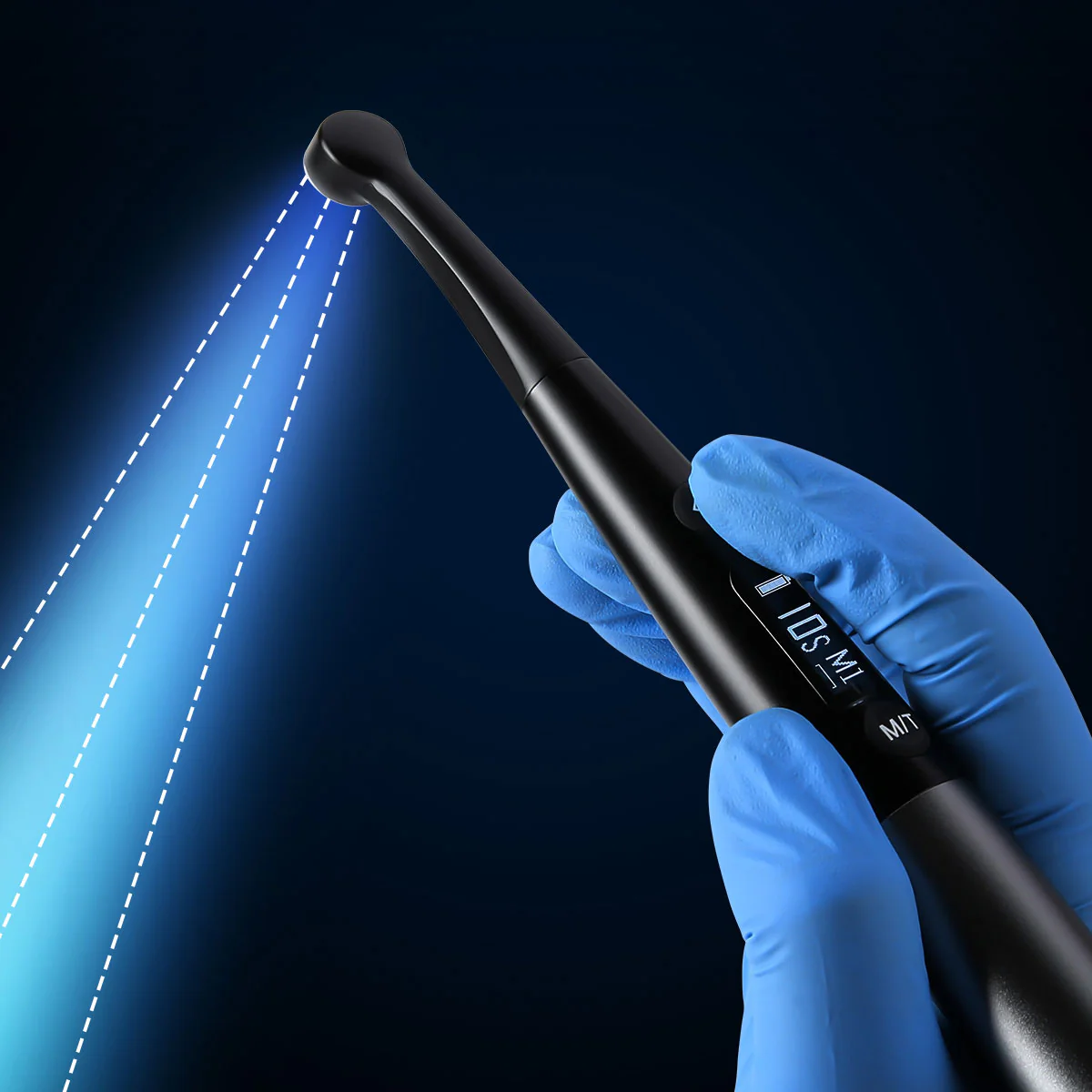
Dental Curing Lights: How They Work, Key Specifications & How to Choose
A dental curing light is a device used to polymerize light-cured dental materials by delivering light within a wavelength range that activates their photoinitiators.
For a curing light to work effectively, however, its performance cannot be judged by a single specification. Wavelength compatibility, irradiance, exposure time, radiant exposure, beam distribution, curing distance, and the characteristics of the material being cured all affect how light energy reaches the material and supports polymerization.
This guide explains how dental curing lights work, which specifications matter, what affects actual curing performance, and what dental buyers should evaluate before selecting or sourcing a curing light.
What Is a Dental Curing Light?
A dental curing light, also called a light-curing unit (LCU), is used to activate the photoinitiators contained in light-cured dental materials.
When the curing light delivers light at a suitable wavelength, the photoinitiator absorbs that light and initiates a chemical reaction that produces reactive species. These initiate polymerization of the resin material, allowing it to transition from an uncured state to a hardened material.
The basic process can be summarized as:
Light source → Wavelength → Photoinitiator → Light absorption → Polymerization → Cured material
Dental curing lights are commonly used with light-cured restorative and other dental materials where controlled light exposure is required.
The important point for evaluating a curing light is that the device and the material must be considered together. A high numerical output does not by itself guarantee effective curing if the wavelength, exposure conditions, beam distribution, or material requirements are not appropriate.
How Does a Dental Curing Light Work?
A dental curing light converts electrical energy into controlled optical energy that is delivered to the dental material through a light-emitting source and light guide or tip.
The curing process involves several connected stages.
1. Light Generation
Modern dental curing lights commonly use LED light sources.
The LED produces light within a defined spectral range. Depending on the design, the device may use a relatively narrow wavelength range or multiple wavelength bands.
2. Wavelength and Photoinitiator Compatibility
The emitted light must overlap with the absorption characteristics of the photoinitiator used by the dental material.
For example, camphorquinone (CQ), a commonly used photoinitiator, has an absorption peak around 469 nm.
However, dental materials may use different photoinitiator systems. Therefore, a curing light should not be evaluated only by its maximum irradiance. Its wavelength or spectral output also needs to be considered in relation to the intended materials.
3. Light Absorption
When the emitted light reaches the dental material, compatible photoinitiators absorb the available optical energy.
The efficiency of this process depends on factors including wavelength, material composition, thickness, shade, and the amount and distribution of light reaching the material.
4. Polymerization
Light absorption activates the photoinitiator and initiates the chemical reactions responsible for polymerization.
The curing result therefore depends on whether sufficient compatible optical energy reaches the material under the actual exposure conditions.
A simplified model is:
Wavelength compatibility + adequate energy delivery + appropriate exposure conditions → effective photopolymerization
This is why curing-light specifications should be evaluated as a group rather than independently.
Types of Dental Curing Lights
Dental curing lights can be differentiated by their light-source and spectral characteristics. For buyers, the important question is not simply which type is newer, but how the output characteristics match the intended materials and applications.
LED Dental Curing Lights
LED technology is widely used in modern dental curing lights because it can provide controlled optical output in a compact device.
Compared with older light-source technologies, LED-based units allow manufacturers to design different wavelength ranges, operating modes, light-guide configurations, and output characteristics.
For procurement purposes, “LED” alone is not a sufficient specification. The actual wavelength range, irradiance, beam profile, exposure modes, and intended applications should also be defined.
Monowave LED Curing Lights
A monowave curing light primarily operates within a narrower wavelength range.
This configuration can be suitable when the intended dental materials use photoinitiators that are effectively activated within the available spectral range.
The key consideration is wavelength compatibility rather than the label “monowave” itself.
Polywave or Broad-Spectrum LED Curing Lights
Polywave or broad-spectrum curing lights use multiple wavelength ranges to provide broader spectral coverage.
This can be relevant when the intended materials use photoinitiators with different absorption characteristics.
However, broader spectral output should not automatically be interpreted as better performance for every application. The appropriate configuration depends on the materials and applications for which the curing light is intended.
When Do These Differences Matter?
The practical decision can be summarized as:
Curing-light type → Spectral output → Photoinitiator compatibility → Material requirements → Application requirements
For buyers comparing different configurations, the useful question is therefore not simply “Which type is best?” but:
Does the optical output of this curing light match the materials and curing conditions for which it will be used?
Dental Curing Light Specifications That Matter
When comparing dental curing lights, several specifications should be considered together.
| Specification | What It Tells You | Why It Matters |
|---|---|---|
| Wavelength / Spectral Range | Emitted wavelength(s) | Photoinitiator compatibility |
| Irradiance | Optical power per unit area | Rate of energy delivery |
| Exposure Time | Duration of exposure | Affects total delivered energy |
| Radiant Exposure | Energy delivered per unit area | Helps evaluate curing dose |
| Beam Profile | Distribution of optical energy | Indicates coverage and uniformity |
| Light Guide / Tip | How light reaches the material | Affects access and positioning |
| Tip Diameter | Effective treatment area | Influences coverage |
| Operating Modes | Available curing programs | Determines exposure flexibility |
| Battery / Charging | Power configuration | Affects workflow |
| Thermal Management | Heat control | Relevant to operating conditions |
A useful specification sheet should therefore provide more than a single maximum irradiance value.
For professional evaluation, the relationship between wavelength, irradiance, exposure time, radiant exposure, and beam distribution is more informative than any one number in isolation.
Irradiance, Power and Radiant Exposure: What Is the Difference?
These terms are often used interchangeably in product descriptions, but they describe different properties.
Power
Radiant power refers to the total optical power emitted by a light source, generally expressed in watts.
It describes the total amount of optical power but does not by itself indicate how that power is distributed across the treatment area.
Irradiance
Irradiance describes optical power delivered per unit area and is commonly expressed in mW/cm².
It indicates the rate at which optical energy is delivered to a particular area.
For example, two curing lights may have different beam areas even if their total optical power is similar. Their irradiance at the target surface may therefore differ.
Radiant Exposure
Radiant exposure describes the amount of radiant energy delivered per unit area and is commonly expressed in J/cm².
A simplified relationship is:
Radiant Exposure = Irradiance × Exposure Time
For example, if a light delivers 1,000 mW/cm² for 10 seconds:
1,000 mW/cm² × 10 s = 10 J/cm²
This illustrates why irradiance should not be considered independently from exposure time.
Does Higher Irradiance Mean Better Curing?
Not necessarily.
A higher irradiance means that optical energy is delivered at a higher rate. It does not automatically mean that the curing light will provide better results under every condition.
Actual curing performance can also depend on:
- wavelength compatibility
- exposure time
- radiant exposure
- beam profile
- curing distance
- tip angle
- material thickness
- material shade and opacity
- photoinitiator system
Therefore, comparing curing lights only by their highest advertised irradiance can provide an incomplete picture of performance.
Why Does Wavelength Matter in Dental Curing?
Wavelength is one of the most important specifications because photoinitiators absorb light within specific spectral regions.
For a curing light to activate a material effectively, its emitted spectrum needs to provide suitable overlap with the absorption characteristics of the material’s photoinitiator.
Camphorquinone (CQ), for example, has an absorption peak around 469 nm. This is one reason blue-light output around this region is commonly associated with curing many resin-based dental materials.
However, not all dental materials necessarily use the same photoinitiator system.
This means that a curing light should be selected according to the materials it is intended to cure rather than based only on a commonly quoted wavelength.
For product evaluation, buyers should therefore review:
- nominal wavelength or wavelength range
- whether the output is monowave or polywave
- intended material compatibility
- spectral information provided by the supplier
- whether the stated wavelength corresponds to the actual optical output of the device
The key relationship is:
Wavelength → Photoinitiator absorption → Light activation → Polymerization
What Affects Actual Curing Performance?
The specifications listed on a product sheet describe the device, but the actual amount and distribution of light reaching the material can change during use.
Several factors should therefore be considered.
Curing Distance
The distance between the light tip and the material can affect the amount of optical energy reaching the target surface.
A curing light specification measured directly at the tip should not automatically be interpreted as the same output available at a greater working distance.
When evaluating a device, consider the conditions under which the stated output was measured.
Tip Angle
The position of the light guide relative to the material can affect how the beam reaches the surface.
An angled or poorly positioned tip may produce a different distribution of optical energy than a tip positioned close to and directly over the target area.
Exposure Time
Exposure time directly affects radiant exposure.
If other conditions remain constant, increasing exposure time increases the total energy delivered to the target area.
For this reason, a stated curing time should always be considered together with irradiance and the material manufacturer’s curing requirements.
Restoration Thickness
Light must travel through the material to reach deeper regions.
As material thickness increases, the amount of light available at greater depth can change.
Curing-light evaluation should therefore take into account the thickness and configuration of the materials for which the device will be used.
Material Shade and Opacity
Material shade, opacity, composition, and other optical characteristics can influence light transmission.
A curing light that performs well under one material condition may not necessarily produce the same energy distribution through a different material.
Beam Profile and Light Distribution
Maximum irradiance is only part of the picture.
The beam profile describes how optical energy is distributed across the illuminated area.
Two devices can have similar peak irradiance values but different beam distributions.
For buyers, this means that beam uniformity and effective coverage can be relevant when comparing curing-light configurations.
How to Choose a Dental Curing Light
Choosing a dental curing light should start with the intended application rather than with the highest advertised specification.
Step 1: Identify the Materials and Applications
Determine which dental materials and procedures the curing light will be used for.
This establishes the technical requirements that follow.
Step 2: Check Wavelength Compatibility
Review the wavelength or spectral range and compare it with the photoinitiator requirements of the intended materials.
Do not assume that one wavelength range is universally suitable for every material.
Step 3: Evaluate Irradiance and Exposure Time Together
Review irradiance together with the available exposure times.
A short curing time may involve a higher energy delivery rate, while another configuration may rely on a longer exposure.
The relevant question is how the device delivers the required energy under the intended curing conditions.
Step 4: Review Radiant Exposure
Consider the energy delivered per unit area rather than relying only on a maximum irradiance figure.
Where specifications are available, compare the relationship between irradiance, exposure time, and radiant exposure.
Step 5: Examine Beam Profile and Tip Configuration
Look at how evenly light is distributed and how the light guide delivers the beam.
Tip diameter, geometry, access, and positioning can all affect practical use.
Step 6: Consider Working Conditions
Evaluate the curing distance, access to the treatment area, exposure workflow, and intended operating environment.
The performance of a curing light should be considered under realistic working conditions rather than only under ideal measurement conditions.
Step 7: Evaluate Workflow and Maintenance Requirements
Once the core optical specifications are suitable, consider:
- battery and charging
- operating modes
- user interface
- light-guide configuration
- cleaning and infection-control requirements
- device ergonomics
- maintenance and documentation
These factors can influence how easily the device fits into the intended clinical workflow.
What Should Dental Buyers Define Before Sourcing a Curing Light?
For distributors, importers, private-label brands, and other professional buyers, defining the technical requirements before requesting quotations makes supplier comparison much more meaningful. These requirements can also be considered within the broader range of clinical dental equipment used in restorative and other routine dental procedures.
Instead of asking only for a “dental curing light,” define the required configuration as specifically as possible.
| Requirement | What to Define |
|---|---|
| Application | Intended materials and clinical applications |
| Wavelength | Required wavelength or spectral range |
| Light Source | LED configuration and spectral characteristics |
| Irradiance | Target output range and measurement conditions |
| Exposure | Available curing times and operating modes |
| Radiant Exposure | Required energy delivery under intended conditions |
| Beam | Beam profile and effective coverage |
| Light Guide | Tip diameter, geometry, and configuration |
| Power | Battery and charging requirements |
| Operation | Interface, controls, and curing modes |
| Documentation | Technical specifications and available test information |
| Branding | Logo, housing, packaging, and labeling requirements |
| Sample | Sample evaluation requirements before larger orders |
For private-label projects, branding requirements can be defined separately from the technical specification.
This helps prevent two different questions from being mixed together:
What should the curing light do?
and
How should the finished product be presented?
A clear technical specification makes it easier to compare quotations, evaluate samples, and confirm whether different suppliers are offering genuinely comparable configurations.
Explore Dental Curing Lights
Once the required wavelength, irradiance, exposure, beam profile, and operating requirements have been defined, the next step is to compare available curing-light configurations against the intended application.
Explore our Dental Curing Lights to review available models and product configurations.
Dental Curing Light FAQ
What is a dental curing light?
A dental curing light is a device that delivers controlled light energy to activate photoinitiators in light-cured dental materials and initiate polymerization.
How does a dental curing light work?
The device emits light within a defined wavelength range. When the light is absorbed by a compatible photoinitiator, it initiates chemical reactions that polymerize the dental material.
What wavelength is used for dental curing?
The appropriate wavelength depends on the photoinitiator used by the dental material. Camphorquinone, for example, has an absorption peak around 469 nm. Other photoinitiator systems may have different absorption characteristics.
What is irradiance in a dental curing light?
Irradiance describes optical power delivered per unit area, commonly expressed in mW/cm². It indicates the rate at which optical energy is delivered to the target area.
Does higher irradiance mean better curing?
Not necessarily. Effective curing depends on wavelength compatibility, irradiance, exposure time, radiant exposure, beam distribution, curing distance, material characteristics, and other conditions.
How do I choose a dental curing light?
Start with the intended materials and applications. Then evaluate wavelength compatibility, irradiance, exposure time, radiant exposure, beam profile, light-guide configuration, working conditions, and workflow requirements.
For professional procurement, these technical requirements should be defined before comparing suppliers or requesting quotations.