Home > Insights > Dental Handpiece Materials: How to Choose Between Stainless Steel, Titanium, Aluminum & Copper Alloys
Dental Handpiece Materials: How to Choose Between Stainless Steel, Titanium, Aluminum & Copper Alloys
Dental handpiece body materials affect weight, balance, durability and ergonomics. Compare stainless steel, titanium, aluminum and copper alloys and learn what dentists and distributors should evaluate before choosing a handpiece.
Dental Handpiece Materials: How to Choose Between Stainless Steel, Titanium, Aluminum & Copper Alloys
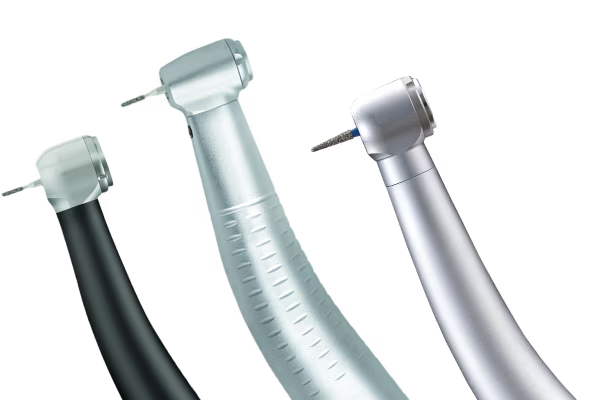
The material used in a dental handpiece body affects more than its appearance. It can influence weight, balance, durability, corrosion resistance, surface characteristics, manufacturing cost, and how the instrument feels in the clinician’s hand.
Stainless steel is widely used in modern dental handpiece construction, while titanium is commonly associated with lightweight and premium designs. Brass and other copper-based materials have also been used in handpiece construction, particularly in older designs or specific components. Aluminum alloys may be considered in designs where low weight and manufacturing flexibility are important.
But choosing a dental handpiece material is not simply a matter of asking which material is “best.”
A more useful question is:
Which material and overall handpiece design provide the right combination of weight, balance, durability, ergonomics, and product positioning for the intended application?
This distinction matters because the lightest handpiece is not automatically the most comfortable, and a heavier handpiece is not automatically more stable. The material is only one part of the complete design.
For dentists, the decision is primarily about handling and clinical use. For distributors and importers, there is another consideration: whether the material supports the positioning, price level, and product differentiation of the handpiece range.
| Material | Main Characteristics | Weight Consideration | Key Advantages | Main Considerations |
|---|---|---|---|---|
| Stainless Steel | Strong, durable, corrosion-resistant | Generally more substantial than lightweight designs | Durability, established use, robust feel | Can add weight |
| Titanium | High strength-to-weight ratio, corrosion-resistant | Lightweight potential | Reduced weight, strength, premium positioning | Higher material and manufacturing cost |
| Aluminum Alloy | Low density, machinable | Lightweight | Weight reduction, manufacturing flexibility | Performance depends strongly on alloy and surface treatment |
| Copper / Copper Alloys | Alloy-dependent mechanical and thermal properties | Generally more substantial than lightweight designs | Useful in specific constructions and components | “Copper” is too broad; exact alloy and application should be verified |
This table is a starting point, not a ranking.
The actual performance of a dental handpiece depends on the material specification, body geometry, manufacturing accuracy, surface treatment, internal components, head design, tubing, and overall weight distribution.
The body material also needs to be considered as part of the complete handpiece mechanism. To understand how the turbine or motor, bearings, spindle, chuck, and other components work together, see our How Does a Dental Handpiece Work? guide.
Why Does Dental Handpiece Body Material Matter?
A dental handpiece is a mechanical instrument that must be small enough for intraoral work while supporting precise, repeated movements.
Its body material can influence several characteristics.
1. Weight
Material density affects the mass of the handpiece.
A heavier construction may give some clinicians a more substantial feel, while a lighter design can reduce the amount of mass supported by the hand and forearm during prolonged procedures.
Dental ergonomics guidance generally recommends handpieces that are as light as practical and well balanced.
However, weight should not be evaluated by itself.
2. Balance
Two handpieces with similar total weights can feel completely different if their weight is distributed differently.
The position of the center of gravity, head size, body geometry, tubing, and coupling can all affect how the instrument behaves in the hand. Dental ergonomics references specifically identify balance as important for both operator fatigue and precision.
3. Durability
The material and its grade influence the body’s resistance to mechanical wear, deformation, and repeated handling.
Stainless steel, for example, is widely used because of its strength, toughness, and corrosion resistance. Titanium can provide a high strength-to-weight ratio while also offering strong corrosion resistance.
4. Corrosion Resistance
Dental handpieces are exposed to water, cleaning agents, disinfectants, and repeated sterilization.
The suitability of a material therefore depends not only on its inherent corrosion resistance but also on its grade, surface treatment, manufacturing process, and the complete handpiece design.
5. Product Positioning
For distributors, material can also become part of the product story.
A titanium body may help differentiate a premium lightweight model. Stainless steel may support a mainstream product positioned around durability and robustness. Aluminum alloy may be considered when weight and cost are important design factors.
The material should support the product’s positioning rather than be used as a substitute for complete product performance.
Stainless Steel Dental Handpieces
Stainless steel is one of the established materials used for modern dental handpiece bodies and chassis. Dental handpiece references commonly identify stainless steel as a durable, corrosion-resistant construction material. citeturn0search1turn0search3
Why Is Stainless Steel Used in Dental Handpieces?
Stainless steel offers a combination of:
- Strength
- Toughness
- Corrosion resistance
- Durability
- Established manufacturing experience
These characteristics make it suitable for reusable clinical instruments that must withstand repeated handling and reprocessing.
Weight and Hand Feel
Stainless steel is denser than titanium and aluminum, so an equivalent design can be more substantial.
This does not automatically make stainless steel less ergonomic.
The important question is how the complete handpiece is balanced.
A well-balanced stainless-steel handpiece may feel predictable and solid, while a poorly balanced design can create unnecessary loading on the hand and forearm.
Clinical ergonomics literature emphasizes that the distribution of weight matters, not simply the total weight.
When Does Stainless Steel Make Sense?
Stainless steel can be considered when the product requires:
- A robust external body
- Good corrosion resistance
- Repeated clinical use
- A more substantial hand feel
- Established manufacturing processes
- A practical balance between performance and cost
For distributors, stainless steel can therefore be a useful foundation for mainstream handpiece products.
Titanium Dental Handpieces
Titanium is particularly relevant when reducing weight without simply sacrificing structural strength is an important design objective.
Dental handpiece literature describes titanium as lighter than stainless steel while providing high strength and resistance to repeated sterilization.
This combination explains why titanium is often associated with premium handpiece designs.
What Are the Advantages of Titanium?
High Strength-to-Weight Ratio
Titanium allows designers to consider a lighter body while maintaining substantial structural performance.
This can be useful when the product is designed around reduced handpiece weight.
Corrosion Resistance
Titanium has strong corrosion resistance, which is one reason it has been used in medical and dental applications.
Lightweight Potential
Reducing handpiece weight can be beneficial for clinicians who use the instrument for extended periods.
However, the important phrase is lightweight potential.
A titanium handpiece is not automatically ergonomic simply because its body is made from titanium.
The final result still depends on:
- Body geometry
- Center of gravity
- Head size
- Grip diameter
- Surface texture
- Tubing
- Overall configuration
When Does Titanium Make Sense?
Titanium may be appropriate when a product is intended to emphasize:
- Reduced weight
- Strength
- Corrosion resistance
- Premium positioning
- Ergonomic design
For distributors, titanium can also provide a clear material-based differentiation within a broader handpiece portfolio.
Aluminum Dental Handpieces
Aluminum alloys can be considered when reducing weight is a major design objective.
However, “aluminum” is not a complete engineering specification.
Different aluminum alloys can have different mechanical and corrosion characteristics, and surface treatment can significantly affect the final properties of the finished component.
For this reason, buyers should not evaluate an aluminum handpiece simply by its material name.
Potential Advantages of Aluminum
Low Density
Aluminum has a relatively low density compared with stainless steel, which makes it attractive for lightweight construction.
Manufacturing Flexibility
Aluminum alloys can be machined into complex geometries, making them useful for certain product designs.
Weight-Oriented Designs
When the product strategy prioritizes low weight, aluminum can be one of the materials considered by the manufacturer.
What Should Buyers Verify?
For an aluminum handpiece, ask:
- What aluminum alloy is used?
- What components are made from aluminum?
- What surface treatment is applied?
- How does the surface treatment affect wear and corrosion resistance?
- What is the complete handpiece weight?
- What are the validated cleaning and sterilization instructions?
This is a more useful purchasing approach than simply asking whether the body is “aluminum.”
Copper and Copper-Alloy Dental Handpieces
Copper requires more careful interpretation than stainless steel or titanium.
The term “copper handpiece” can be misleading because it does not necessarily identify a specific engineering material.
A supplier may be referring to:
- Pure copper
- Brass
- Another copper alloy
- An internal component
- A copper-containing part of the assembly
Historically, brass has been used in dental handpiece construction. Modern handpiece references note that stainless steel has largely replaced brass for many external body applications because of its durability and corrosion-resistance advantages.
Therefore, a professional buyer should not treat “copper” as a universal material category.
What Should a Buyer Ask?
If a supplier describes a handpiece as copper or copper alloy, clarify:
- What exact material or alloy is used?
- Is it used for the external body or an internal component?
- What surface treatment is applied?
- What is the complete handpiece weight?
- What are the sterilization instructions?
- What role does the material play in the product design?
This is particularly important when comparing specifications from different suppliers.
Is a Lighter Dental Handpiece Always Better?
Not necessarily.
This is one of the most important points to understand when comparing dental handpieces.
Dental ergonomics literature generally favors handpieces that are lightweight and well balanced because excessive weight can contribute to operator fatigue.
But lightweight and stable are not opposites, and weight alone does not determine control.
A handpiece’s handling characteristics are influenced by several variables:
Weight + Center of Gravity + Balance + Grip + Head Geometry + Tubing
Together, these factors determine much of how the handpiece feels during use.
Why Can a Slightly Heavier Handpiece Feel More Stable?
Some clinicians prefer a handpiece with a slightly more substantial feel.
The additional mass may give the instrument a solid or predictable tactile feel for that particular user.
This is a reasonable clinical preference, but it should not be turned into a universal ergonomic rule.
Professional dental references specifically note that whether a clinician prefers a heavier or lighter handpiece can be a matter of personal preference, while also noting that heavier instruments can increase fatigue more quickly.
Therefore:
A heavier handpiece may feel more stable to some clinicians, but heavier does not automatically mean more ergonomic.
The more useful question is whether the handpiece is appropriately balanced for the user and application.
Weight vs. Balance: Which Matters More?
Consider two hypothetical handpieces:
Handpiece A
- 70 g
- Poor weight distribution
- Head-heavy
- Small grip
Handpiece B
- 80 g
- Well distributed weight
- Neutral balance
- Appropriate grip diameter
A clinician may not necessarily prefer Handpiece A simply because it is 10 g lighter.
This illustrates an important principle:
Total weight is only one part of ergonomic performance.
Dental ergonomics literature specifically identifies balance, grip, head geometry, hand size, and tubing as factors that affect handpiece handling.
The best way to evaluate a handpiece is therefore not to hold the body alone.
The handpiece should be assessed in its actual working configuration, including the appropriate tubing or coupling. Dental Economics specifically recommends evaluating the handpiece with the proper tubing attached because the complete setup affects its weight and feel.
What Other Ergonomic Factors Should Buyers Evaluate?
Material affects weight, but it does not determine ergonomics by itself.
Grip Diameter
The diameter of the handpiece affects how much force the clinician needs to maintain control.
A larger grip can allow a more relaxed grasp in some situations, while the appropriate diameter also depends on hand size and personal preference.
Surface Texture
A smooth or knurled surface can produce different grip characteristics.
Knurling can improve friction and control, particularly when gloves are worn, although the texture must still be compatible with cleaning and sterilization requirements.
Head Size and Geometry
Head size and angulation affect access, visibility, and working position.
A material change cannot compensate for a head design that is unsuitable for the intended application.
Tubing and Coupling
The handpiece should be evaluated with its intended tubing and coupling.
A heavy or inflexible hose can affect the apparent weight and balance of the instrument.
This is another reason why simply comparing the body material is not enough.
Stainless Steel vs. Titanium vs. Aluminum vs. Copper: How Should You Compare Them?
The right comparison depends on what the buyer is trying to optimize.
If low weight is a priority
Titanium and suitable aluminum-alloy designs may be considered.
However, compare the actual finished handpiece weight and balance, not just the material.
If durability and a robust construction are priorities
Stainless steel may be an appropriate option because of its established strength, toughness, and corrosion resistance.
If premium lightweight positioning is important
Titanium can support a product positioned around low weight, strength, and material differentiation.
But the premium proposition should also be supported by the rest of the handpiece specification.
If a supplier specifies copper
Ask for the exact alloy and application.
“Pure copper,” “brass,” and other copper alloys should not be treated as interchangeable specifications.
How Should Dental Handpiece Distributors Choose the Material?
For a distributor, the material decision has an additional dimension that clinicians may not consider:
How does the material support the product range you are trying to sell?
A distributor is not simply buying a metal body.
The distributor is building a product portfolio.
1. Define the Target Price Level
Before selecting the material, establish the intended market position.
A value-oriented product may prioritize:
- Practical specifications
- Cost control
- Adequate durability
- Easy product differentiation
A mainstream product may emphasize:
- Durability
- Ergonomics
- Features
- Price-performance balance
A premium product may emphasize:
- Material
- Weight
- Finish
- Ergonomics
- Additional features
- Product differentiation
Material can support these positions, but it should not define them by itself.
Material is only one part of the overall selection process. For a broader comparison of handpiece specifications, compatibility, performance, and purchasing considerations, see our Dental Handpiece Buying Guide.
2. Define the Clinical Use
Consider whether the product is intended primarily for:
- General restorative procedures
- High-speed preparation
- Low-speed procedures
- Polishing
- Endodontic applications
- Surgical or other specialized applications
The body material should be evaluated together with the actual handpiece configuration.
3. Compare Complete Product Specifications
A distributor should compare more than body material.
Important specifications can include:
- High-speed or low-speed configuration
- Head size
- Standard or high-torque head
- Water spray configuration
- Connection type
- LED lighting
- Chuck system
- Bearing system
- Speed
- Torque
- Vibration
- Weight
- Balance
- Sterilization requirements
- Maintenance requirements
A titanium body does not automatically make a handpiece a better choice if another model has a more suitable configuration for the target market.
Material is also only one part of overall handpiece quality. For a broader look at engineering precision, manufacturing consistency, and other factors that affect handpiece quality, see our Dental Handpiece Quality Guide.
4. Evaluate Differentiation
If several competing handpieces have similar speed, spray, connection, and LED specifications, material can become one of the factors used to differentiate the product.
But the strongest product positioning usually combines several meaningful characteristics rather than relying on a single material claim.
For example:
Lightweight body + balanced design + LED + appropriate head configuration
is a stronger product proposition than simply:
Titanium body.
What Should Distributors Ask a Dental Handpiece Supplier?
Before purchasing a new model, buyers can use the following checklist.
Material
- What material is used for the external body?
- What specific alloy or material grade is used?
- Which components use that material?
- Is the stated material used for the complete body or only selected parts?
Weight and Balance
- What is the complete handpiece weight?
- Where is the center of gravity?
- How does the handpiece balance with the intended tubing or coupling?
- Are different body or configuration options available?
Surface and Grip
- What surface treatment is applied?
- What type of grip texture is used?
- How does the surface finish perform after repeated cleaning and sterilization?
Sterilization
- Is the complete handpiece designed for repeated heat sterilization?
- What are the manufacturer’s cleaning and sterilization instructions?
- Are there component-specific limitations?
Configuration
- What head configurations are available?
- Are standard and high-torque heads available?
- What water spray configurations are available?
- Is LED lighting available?
- What connection options are available?
- What chuck and bearing systems are used?
Commercial Requirements
- Are samples available for evaluation?
- Can the product be supplied under a private label?
- Can packaging and logo printing be customized?
- Can different configurations be developed around the same product platform?
- Can specifications be adapted to the requirements of a particular market?
These questions help buyers evaluate the actual product rather than relying on broad descriptions such as “premium material” or “lightweight design.”
What Is the Best Material for a Dental Handpiece?
There is no single material that is universally best for every dental handpiece.
The appropriate choice depends on what the product needs to achieve.
Stainless steel can be appropriate when durability, corrosion resistance, established construction, and a substantial feel are priorities.
Titanium can be attractive when low weight, strength, corrosion resistance, and premium positioning are important.
Aluminum alloys may be considered when low weight and manufacturing flexibility are important, provided that the alloy and surface treatment are appropriate for the intended application.
Copper and copper alloys require more specific evaluation because the term “copper” does not identify a single material or construction method.
Most importantly, the material should not be evaluated independently from the rest of the handpiece.
A better selection framework is:
Material → Weight → Balance → Grip → Head Geometry → Configuration → Clinical Application → Market Positioning
This provides a more useful basis for comparing dental handpieces than simply asking which material is the strongest or lightest.
Final Buyer Checklist
Before selecting a dental handpiece, ask these questions:
Material
- What is the body made from?
- What exact alloy or grade is used?
- Which parts use that material?
Ergonomics
- What is the complete weight?
- Where is the center of gravity?
- Does the handpiece feel balanced with its actual tubing?
- Is the grip appropriate for the intended user?
Clinical Configuration
- What head design is used?
- What water spray configuration is available?
- Is LED lighting required?
- What connection, chuck, and bearing systems are used?
Reprocessing
- What are the manufacturer’s cleaning and sterilization instructions?
- Is the complete handpiece designed for repeated heat sterilization?
Commercial Positioning
- Does the material provide a meaningful advantage for the target market?
- Does the product fit the intended price level?
- Can the configuration be differentiated from competing products?
- Can the supplier support samples, packaging, branding, or other private-label requirements?
The material is an important specification, but it is not the whole product.
For buyers comparing handpieces, the most useful approach is to evaluate material, weight, balance, configuration, clinical application, and market positioning together.
To compare different high-speed, low-speed, and contra-angle configurations, explore our Dental Handpieces range and review the specifications that matter for your target application and market.
- Why Is Stainless Steel Used in Dental Handpieces?
- What Are the Advantages of Titanium?
- Potential Advantages of Aluminum
- What Should Buyers Verify?
- What Should a Buyer Ask?
- Why Can a Slightly Heavier Handpiece Feel More Stable?
- Grip Diameter
- Surface Texture
- Head Size and Geometry
- Tubing and Coupling
- 1. Define the Target Price Level
- 2. Define the Clinical Use
- 3. Compare Complete Product Specifications
- 4. Evaluate Differentiation
- Material
- Weight and Balance
- Surface and Grip
- Sterilization
- Configuration
- Commercial Requirements