How to Choose a NiTi Rotary File System: Size, Taper, Sequence & Design
Learn how to choose a NiTi rotary file system by comparing tip size, taper, file sequence, cross-sectional design, heat treatment, motion, and manufacturing quality. A practical guide for dentists, dental distributors, importers, and OEM brands.
How to Choose a NiTi Rotary File System: Size, Taper, Sequence & Design
Choosing a NiTi rotary file system is not simply a matter of selecting the smallest file, the highest taper, or the shortest sequence.
A rotary file system is a coordinated set of endodontic instruments in which tip size, taper, cross-sectional design, cutting geometry, alloy treatment, file sequence, and motion are designed to work together.
For dentists, the key question is not simply: Which NiTi rotary file is the best?
A better question is: Which NiTi rotary file system provides the right combination of file size, taper, sequence, flexibility, cutting efficiency, and clinical control for the intended canal anatomy and treatment workflow?
For dental distributors, importers, and private-label brands, there is another important question:
How do I evaluate whether a NiTi rotary file system is technically suitable and commercially reliable before adding it to my product portfolio?
This guide explains the main factors to consider when choosing and comparing a NiTi rotary file system, including size, taper, sequence, file design, NiTi alloy, heat treatment, motion, and supplier specifications.
What Is a NiTi Rotary File System?
A NiTi rotary file system is a coordinated group of nickel-titanium endodontic files designed to mechanically shape root canals using engine-driven rotation or another manufacturer-specified motion.
Unlike an individual rotary file, a complete system is defined by how multiple files work together. If you are new to NiTi instrumentation, start with our guide to What Is a NiTi Rotary File?
A system may include:
- Orifice-opening or shaping files
- Glide-path files
- Coronal shaping files
- Intermediate shaping files
- Apical finishing files
- Different tip sizes
- Different tapers
- Different working lengths
- Different cross-sectional geometries
- Different heat-treated NiTi alloys
- Specific speed and torque recommendations
The performance of the system therefore depends on the relationship between these components rather than on one specification alone.
A file with excellent flexibility may not be efficient if its cutting geometry is poorly matched to the intended application.
Likewise, a file with a large taper may provide rapid enlargement in some situations but may not be appropriate for every canal anatomy.
The right NiTi rotary file system is the one whose overall design is appropriate for its intended workflow and application.
NiTi Rotary File vs. NiTi Rotary File System
The terms are closely related, but they should not be treated as identical.
A NiTi rotary file is an individual instrument.
A NiTi rotary file system is a coordinated sequence of instruments designed to perform different stages of canal preparation.
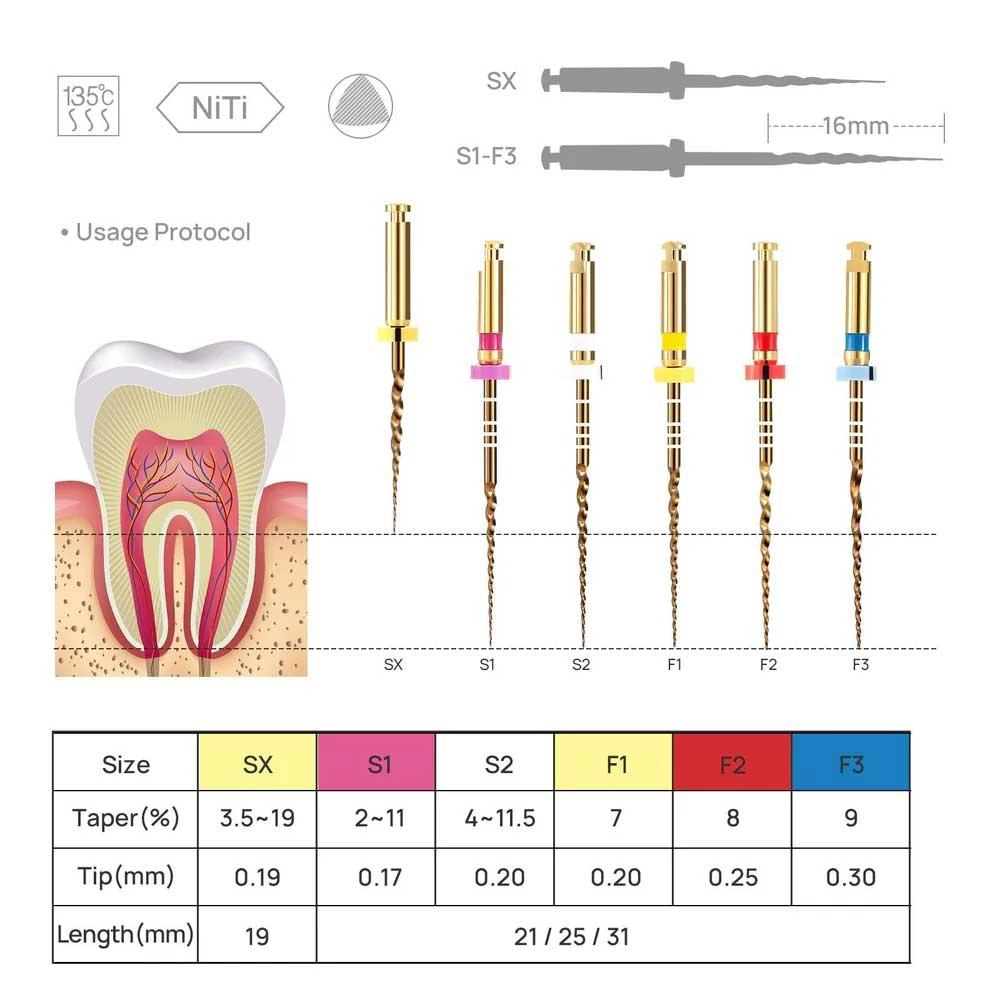
For example, a system may contain several instruments with different combinations of tip size and taper:
| File | Tip Size | Taper | Primary Function |
|---|---|---|---|
| Shaping File | #18 | Variable | Coronal shaping |
| Shaping File | #20 | Variable | Canal enlargement |
| Finishing File | #20 | .07 | Apical preparation |
| Finishing File | #25 | .08 | Larger apical preparation |
| Finishing File | #30 | .09 | Further enlargement |
The exact specifications vary between manufacturers and systems.
The important point is that the files are designed to work together.
This is why evaluating only one file from a NiTi rotary file system can provide an incomplete picture of the product.
The Main Factors to Evaluate When Choosing a NiTi Rotary File System
When comparing NiTi rotary file systems, evaluate at least these six factors:
- Tip size
- Taper
- File sequence
- Cross-sectional and cutting design
- NiTi alloy and heat treatment
- Motion and operating parameters
For dental distributors, importers, and private-label brands, three additional factors are important:
- Manufacturing consistency
- Technical documentation
- OEM and private-label capability
These factors are interconnected.
A system should not be judged by a single specification such as taper, file count, or heat treatment.
1. NiTi Rotary File Size: What Does the Tip Size Mean?
Tip size is one of the most important specifications of an endodontic file.
The ISO tip size indicates the nominal diameter of the file at its tip.
For example:
- #20 = approximately 0.20 mm tip diameter
- #25 = approximately 0.25 mm tip diameter
- #30 = approximately 0.30 mm tip diameter
- #35 = approximately 0.35 mm tip diameter
- #40 = approximately 0.40 mm tip diameter
The tip size describes the diameter at the tip, not the diameter of the entire working portion.
This distinction becomes particularly important when comparing files with different tapers.
For example:
- 25/.04
- 25/.06
- 25/.08
All have a nominal #25 tip size, but their diameters increase at different rates along the working portion.
Therefore, choosing a NiTi rotary file based only on tip size is incomplete.
A more useful comparison is: Tip size + taper + working length + file geometry
Tip Size vs. Taper
| Specification | What It Describes | Why It Matters |
|---|---|---|
| Tip size | Diameter at the file tip | Influences the size of the prepared apical portion |
| Taper | Rate of diameter increase | Influences canal enlargement |
| Working length | Length used during preparation | Determines how the instrument reaches the intended canal region |
| Cross-section | Shape of the working portion | Influences cutting behavior and flexibility |
This is why two #25 files can behave differently even when their nominal tip sizes are identical.
2. What Is Taper in a NiTi Rotary File?
Taper describes how quickly the diameter of a file increases from its tip toward the shank.
For a constant-taper file, a .04 taper means that the diameter increases by approximately 0.04 mm for each additional millimeter from the tip.
For example, a nominal 25/.04 file has:
- Tip diameter: 0.25 mm
- Approximate diameter 1 mm from the tip: 0.29 mm
- Approximate diameter 2 mm from the tip: 0.33 mm
A 25/.08 file increases in diameter more rapidly.
This means taper has a major influence on the shape produced by the instrument.
Common NiTi File Tapers
Common taper specifications include:
- .02
- .04
- .05
- .06
- .08
- .10
Some NiTi rotary file systems also use variable or progressive tapers.
The taper should therefore always be evaluated together with the tip size. A larger taper is not automatically a better taper.
The appropriate taper depends on the file’s intended role, geometry, sequence, and the anatomy for which the system is designed.
3. Constant Taper vs. Variable Taper
Not every NiTi rotary file system uses the same taper design.
A constant-taper file maintains the same nominal taper along its working portion.
A variable-taper file changes its taper along different sections of the instrument.
Variable taper can be used to create different shaping characteristics along the canal while reducing the need for multiple instruments with identical geometries.
This is one reason some modern NiTi rotary systems can use relatively short sequences.
However, a shorter sequence should not automatically be interpreted as a superior system.
The more important question is: How effectively does the sequence distribute the shaping task between the individual files?
A well-designed system should have a logical relationship between:
- File diameter
- Taper
- Cutting geometry
- Flexibility
- Working length
- Intended position in the sequence
4. How Does a NiTi Rotary File Sequence Work?
A NiTi rotary file system is essentially a workflow.
The files are normally designed to perform different stages of canal preparation.
A simplified conceptual sequence may look like:
Access → Glide Path → Coronal Shaping → Canal Shaping → Apical Finishing
Not every commercial system uses exactly this structure.
Some systems use multiple shaping instruments. The file sequence should also be considered together with the type of instrument motion used by the system. For a broader comparison, see our guide to Rotary vs. Reciprocating Files.
Others use fewer files.
Some systems are designed around simplified workflows.
The important point is that each file should have a defined role within the system.
Example of a Multi-File Sequence
A simplified conceptual sequence might be:
| Stage | File Type | Main Objective |
|---|---|---|
| 1 | Glide Path File | Establish a predictable path |
| 2 | Orifice Shaper | Enlarge the coronal region |
| 3 | Shaping File | Develop the main canal shape |
| 4 | Intermediate File | Continue controlled enlargement |
| 5 | Finishing File | Establish the desired apical size |
The actual sequence, file dimensions, speed, torque, and usage protocol should always follow the manufacturer’s instructions for the specific system.
Why File Sequence Matters
The sequence determines how much work is performed by each instrument.
If one file is expected to perform too much enlargement, the mechanical load on that file may increase.
If a system contains unnecessary instruments, the workflow may become more complicated.
A well-designed sequence attempts to balance:
- Cutting efficiency
- Flexibility
- Instrument stress
- Canal anatomy
- Debris removal
- Preparation efficiency
- Number of instruments required
This is why comparing systems simply by the number of files can be misleading.
A three-file system is not automatically better than a five-file system.
The better question is: How efficiently does the sequence distribute canal shaping across the available instruments?
5. Why NiTi Rotary File Design Matters
The physical design of a NiTi rotary file strongly influences its behavior.
Important design features include:
- Cross-sectional geometry
- Cutting edge design
- Core diameter
- Flute depth
- Helical angle
- Pitch
- Rake angle
- Tip design
- Taper
- Surface treatment
- Heat treatment
These features should not be evaluated independently.
They work together to determine how the instrument interacts with dentin.
Cross-Sectional Design
The cross-section determines how much metal is present in the working portion and how the cutting edges interact with the canal wall.
A larger core can influence structural strength but may also affect flexibility.
A reduced core can increase flexibility but may change resistance to torsional loading.
Therefore: More metal does not automatically mean a better file.
The appropriate balance depends on the intended application and overall file design.
Different manufacturers use different cross-sectional geometries to achieve different combinations of:
- Cutting efficiency
- Flexibility
- Debris space
- Centering behavior
- Resistance to mechanical stress
Flute and Groove Design
The flutes and grooves provide space for dentin debris to move away from the cutting area.
Flute geometry can influence:
- Cutting efficiency
- Debris removal
- Contact area
- Friction
- Instrument loading
A file that cuts aggressively is not necessarily the best choice if its geometry produces excessive engagement.
The objective is controlled cutting rather than maximum cutting force.
Pitch and Helical Design
Pitch refers to the distance between corresponding points of the file’s helical structure.
The relationship between pitch, helix angle, flute geometry, and cutting edges influences the instrument’s behavior inside the canal.
Manufacturers may modify these parameters to balance:
- Cutting efficiency
- Debris transportation
- Flexibility
- Screwing-in tendency
- Mechanical stress
This is one reason two files with identical tip size and taper can behave differently.
6. NiTi Alloy and Heat Treatment
Modern NiTi rotary files are available in different metallurgical conditions.
Heat treatment can modify the mechanical behavior of NiTi and may influence properties such as:
- Flexibility
- Transformation behavior
- Controlled-memory characteristics
- Cyclic fatigue resistance
- Resistance to deformation
This can be particularly relevant when a file is intended for challenging canal anatomy.
However, “heat-treated” should not be treated as a guarantee of superior overall performance.
The final behavior of a file depends on the combination of: Alloy + heat treatment + geometry + dimensions + manufacturing quality
Two heat-treated files can therefore behave differently. For a more detailed explanation, see our guide to How Heat Treatment Improves File Flexibility in Modern Endodontics.
This is an important consideration when comparing NiTi rotary file suppliers.
For a deeper discussion of this topic, see:
How Heat Treatment Improves File Flexibility in Modern Endodontics
7. Rotary Motion and NiTi File System Design
Another important factor is the motion specified by the manufacturer.
NiTi instruments may be designed for:
- Continuous rotation
- Reciprocating motion
- Specific manufacturer-defined motion patterns
This article focuses primarily on rotary file systems.
However, motion should not be separated from file design.
A file engineered for one type of motion should not automatically be assumed to perform identically under another motion.
Speed and torque settings should also be determined according to the manufacturer’s instructions.
Do not select operating parameters simply because another NiTi system uses the same file size or taper.
How to Compare Two NiTi Rotary File Systems
When comparing two systems, avoid looking only at marketing claims.
A structured comparison is more useful.
NiTi Rotary File System Comparison Checklist
This type of comparison is more useful than comparing price alone.
How to Choose the Right NiTi Rotary File System
| Factor | System A | System B |
|---|---|---|
| Alloy | ||
| Heat treatment | ||
| Motion | ||
| Tip sizes | ||
| Tapers | ||
| Variable taper | ||
| Cross-section | ||
| Cutting edge | ||
| File sequence | ||
| Number of files | ||
| Working lengths | ||
| Recommended speed | ||
| Recommended torque | ||
| Glide path requirement | ||
| Intended application | ||
| Packaging | ||
| Sterile/non-sterile options | ||
| OEM/private label |
There is no universal “best” NiTi rotary file system.
The right system depends on the intended clinical workflow, canal anatomy, operator preference, and product requirements.
A practical evaluation can follow seven steps.
Step 1: Define the Intended Application
First determine what the system is intended to achieve.
Consider:
- General root canal preparation
- Narrow canals
- Curved canals
- Larger canals
- Conservative preparation
- Simplified preparation
- Faster workflow
- Multi-file preparation
A system should be selected according to its intended application rather than its marketing description.
Step 2: Check the Available Tip Sizes
Review the complete size range rather than only the most frequently promoted file.
Ask:
- What is the smallest available tip?
- What is the largest finishing size?
- Are intermediate sizes available?
- Are the sizes logically distributed?
- Are the sizes suitable for the intended market?
For distributors, this is particularly important because a product portfolio needs sufficient size coverage.
Step 3: Analyze the Taper Structure
Look at the taper of every file in the sequence.
Ask:
- Is the taper constant or variable?
- How quickly does the taper increase?
- Are large tapers concentrated in specific files?
- Is the taper appropriate for the intended workflow?
- Does the system provide different taper options?
The goal is not to choose the largest taper.
The goal is to understand how taper is used within the system.
Step 4: Analyze the File Sequence
Map every file according to its role.
For example:
Orifice → Shaping → Finishing
or:
Shaping 1 → Shaping 2 → Finishing 1 → Finishing 2
Then ask:
- Does each file have a clear purpose?
- Is the progression logical?
- Does the system require unnecessary file changes?
- Is the sequence easy to learn?
- Can distributors explain the workflow easily to customers?
For a commercial product, simplicity can be a significant advantage.
Step 5: Evaluate the File Design
Look at:
- Cross-section
- Core
- Flutes
- Cutting edges
- Tip
- Helical angle
- Pitch
- Surface treatment
The objective is to determine whether the geometry supports the claimed application.
A professional product evaluation should go beyond: “This is a gold file.”
Instead ask: “What does the metallurgical treatment do, and how does it interact with the file geometry?”
Step 6: Verify the Manufacturer’s Specifications
Before purchasing or private-labeling a system, request technical documentation.
At minimum, distributors should be able to obtain:
- Product specifications
- File dimensions
- Size/taper chart
- Available lengths
- Recommended speed
- Recommended torque
- Intended motion
- Usage instructions
- Packaging information
- Material/alloy information
- Quality documentation
For OEM buyers, this information is particularly important.
A supplier that cannot clearly provide its own product specifications should be evaluated carefully.
If you are evaluating available NiTi rotary files for clinical or distribution requirements, review the complete product range and compare specifications before making a selection.
How Dental Distributors Should Evaluate a NiTi Rotary File Supplier
For distributors and importers, selecting the file system is only half of the decision.
The supplier behind the product can determine whether the product becomes a successful SKU or a recurring quality problem. For a detailed supplier evaluation framework, see our guide to choosing a reliable NiTi rotary file supplier.
1. Product Consistency
Ask whether the supplier can maintain consistent:
- Tip size
- Taper
- Working length
- Cutting geometry
- Surface finish
- Heat-treatment condition
- Packaging
Consistency matters because distributors need repeat orders to match the original approved samples.
2. OEM and Private Label Capability
If you are developing your own dental brand, evaluate whether the supplier can support:
- Private-label packaging
- Custom labels
- Product naming
- Customized assortment
- Packaging design
- Barcode requirements
- Batch/lot identification
- Documentation
- Export packaging
OEM should not simply mean putting a logo on an existing box.
A reliable OEM supplier should be able to maintain the agreed product specification throughout repeat production.
3. Sample-to-Mass-Production Consistency
One of the most important questions for a distributor is: “Will the production batch match the approved sample?”
Before placing a large order, establish a clear product specification sheet.
The specification should define:
- File size
- Taper
- Length
- Geometry
- Material
- Heat treatment
- Packaging
- Quantity per box
- Label information
This reduces ambiguity between the buyer and manufacturer.
A Practical NiTi Rotary File System Evaluation Framework
For professional buyers, a useful evaluation model is: System Value = Clinical Design + Mechanical Performance + Workflow Efficiency + Manufacturing Consistency + Commercial Fit
Each component matters.
Clinical Design
Does the system make sense for the intended application?
Mechanical Performance
Does the combination of alloy and geometry provide the required mechanical characteristics for the intended use?
Workflow Efficiency
Is the sequence logical and practical?
Manufacturing Consistency
Can the manufacturer reproduce the agreed specification reliably?
Commercial Fit
Can the product be packaged, positioned, priced, and supported for the target market?
This framework is more useful than asking whether a file is simply “good” or “bad.”
Common Mistakes When Choosing a NiTi Rotary File System
Mistake 1: Choosing the System With the Fewest Files
A shorter sequence can simplify workflow.
But fewer files do not automatically mean better performance.
The design of each file and the distribution of workload across the sequence matter more than the number alone.
Mistake 2: Choosing the Largest Taper
A larger taper may provide faster enlargement in some parts of the canal, but taper must be considered together with anatomy, tip size, geometry, and the complete system design.
More aggressive shaping is not automatically better.
Mistake 3: Comparing Only Tip Sizes
A #25 file can have different tapers and different geometries.
Therefore: #25 does not tell you enough about a file.
Always compare tip size, taper, cross-section, alloy, and intended position in the sequence.
Mistake 4: Assuming All Gold or Blue Files Are the Same
Color terminology is not sufficient to evaluate metallurgy.
Different manufacturers may use different heat-treatment processes and different file geometries.
The actual product specification matters more than the color name.
Mistake 5: Choosing Based Only on Price
A low unit price may look attractive to a distributor.
But the total commercial value also depends on:
- Product consistency
- Packaging
- Documentation
- Defect rate
- Repeatability
- MOQ
- OEM support
- Lead time
- Customer complaints
- After-sales support
A slightly higher unit cost can be commercially better if the product is more consistent and easier to support in the market.
NiTi Rotary File System Buying Checklist
Before selecting a system, ask these questions. You can also review our NiTi rotary files collection to compare available file configurations and product specifications.
Product Design
- What alloy is used?
- Is the file heat-treated?
- What type of heat treatment is used?
- What are the available tip sizes?
- What tapers are available?
- Is the taper constant or variable?
- What is the cross-sectional geometry?
- What is the intended motion?
- What is the recommended speed?
- What is the recommended torque?
System Design
- How many files are included?
- What is the role of each file?
- What is the recommended sequence?
- Is a glide path required?
- Are additional shaping files available?
- Are different finishing sizes available?
Manufacturing
- What is the production capacity?
- How is dimensional consistency controlled?
- How is heat treatment controlled?
- How are files inspected?
- What quality documentation is available?
- Can the manufacturer provide batch traceability?
Commercial Requirements
- What is the MOQ?
- What packaging options are available?
- Is OEM/private label available?
- Can the supplier provide custom packaging?
- What is the normal production lead time?
- Can the supplier support repeat orders?
- Can the same specification be maintained over multiple batches?
NiTi Rotary File System FAQs
What is a NiTi rotary file system?
A NiTi rotary file system is a coordinated set of nickel-titanium endodontic instruments designed to shape root canals using a specified engine-driven motion. The system may contain shaping, finishing, and other specialized files with different tip sizes, tapers, and geometries.
How do I choose a NiTi rotary file system?
Start by evaluating the intended application, then compare tip sizes, tapers, file sequence, cross-sectional geometry, alloy and heat treatment, motion, and manufacturer specifications. For distributors, also evaluate product consistency, documentation, OEM capability, MOQ, and repeat-order reliability.
What is the difference between NiTi file size and taper?
Tip size describes the nominal diameter at the file tip, while taper describes how quickly the file diameter increases along its working portion. Both specifications should be evaluated together.
Is a larger taper better?
Not necessarily. Taper is a design parameter rather than a quality rating. The appropriate taper depends on the complete file geometry, tip size, sequence, and intended application.
Are heat-treated NiTi files better?
Heat treatment can modify the mechanical behavior of NiTi and may influence properties such as flexibility or cyclic fatigue resistance depending on the alloy and manufacturing process. However, heat treatment should be evaluated together with geometry, dimensions, and manufacturing quality.
How many files should a NiTi rotary system have?
There is no universally ideal number. A shorter sequence may simplify workflow, while additional files may allow more gradual shaping. The quality of the sequence and the role of each file are more important than the number of files alone.
What should distributors look for in a NiTi rotary file supplier?
Distributors should evaluate product specifications, dimensional consistency, manufacturing quality, documentation, packaging, MOQ, lead time, OEM/private-label capability, and the supplier’s ability to reproduce the approved specification consistently.
Can NiTi rotary files be private labeled?
Many NiTi rotary file manufacturers support OEM and private-label programs. Buyers should confirm the exact product specification, packaging requirements, quality documentation, MOQ, and sample-to-production consistency before placing a commercial order.
Final Checklist: How to Choose a NiTi Rotary File System
Before selecting a NiTi rotary file system, evaluate it in this order:
1. Intended application
↓
2. Tip size range
↓
3. Taper structure
↓
4. File sequence
↓
5. Cross-sectional and cutting design
↓
6. NiTi alloy and heat treatment
↓
7. Motion, speed and torque
↓
8. Manufacturing consistency
↓
9. Documentation and quality control
↓
10. OEM/private-label and commercial requirements
The most important principle is simple: Do not evaluate a NiTi rotary file system by one specification. Evaluate the system as a complete design.
Tip size, taper, sequence, geometry, alloy, heat treatment, and manufacturing quality all contribute to the final product.
For dentists, this means selecting a system that fits the intended workflow and canal anatomy.
For distributors and dental brands, it means selecting a system that is not only technically credible, but also consistent, documented, scalable, and commercially supportable.
A reliable NiTi rotary file supplier should be able to explain not only what files are included in the system, but also why the system is designed that way and how the specification can be maintained from sample to repeat production.