Apex Locators vs Traditional Working Length Methods
Accurate working length determination is one of the most important factors in successful root canal treatment. Traditionally, dentists relied on radiographic techniques to estimate canal length. Today, electronic apex locators have become a widely adopted tool for improving accuracy and efficiency. This article compares apex locators with traditional working length methods and explains why electronic measurement has become an essential part of modern endodontic practice.
Apex Locators vs Traditional Working Length Methods
Successful root canal treatment depends on effective cleaning, shaping, and obturation of the root canal system.
Among the many factors that influence treatment outcomes, accurate working length determination remains one of the most critical.
Working length refers to the distance from a coronal reference point to the point where canal preparation and obturation should ideally terminate.
If the working length is inaccurate, clinicians may encounter:
– Incomplete canal cleaning
– Residual infection
– Over-instrumentation
– Periapical tissue damage
– Reduced treatment success rates
For decades, radiographic methods were the primary technique used to estimate working length. Today, electronic apex locators have become a standard tool in modern endodontics, helping clinicians achieve greater accuracy and efficiency.
This article explores the differences between traditional working length determination methods and electronic apex locator technology.
Why Working Length Matters
The objective of root canal treatment is to clean and shape the canal system while preserving surrounding tissues.
Determining the correct working length helps clinicians:
– Remove infected tissue effectively
– Avoid unnecessary over-preparation
– Improve obturation quality
– Reduce postoperative complications
– Enhance long-term treatment outcomes
Even small measurement errors can significantly affect treatment success.
Traditional Working Length Determination
Before electronic apex locators became widely available, dentists primarily relied on radiographic techniques.
How It Works
The clinician places a file into the canal and takes a radiograph.
Based on the image, the file position is evaluated relative to the radiographic apex, and adjustments are made until the desired length is achieved.
Advantages of Traditional Methods
Familiar Workflow
Radiographic techniques have been used for decades and remain familiar to most clinicians.
Visual Confirmation
Radiographs provide valuable anatomical information regarding:
– Root morphology
– Canal curvature
– Surrounding structures
– Periapical conditions
Universal Availability
Most dental clinics already have access to radiographic equipment.
Limitations of Traditional Methods
Two-Dimensional Imaging
Radiographs provide only a two-dimensional representation of a three-dimensional structure.
Important anatomical variations may not always be visible.
Potential Distortion
Image angulation and positioning can influence measurement accuracy.
Increased Radiation Exposure
Although modern radiography minimizes exposure, repeated measurements may still increase cumulative radiation.
Time Consumption
Multiple radiographs may be required during treatment.
What Is an Apex Locator?
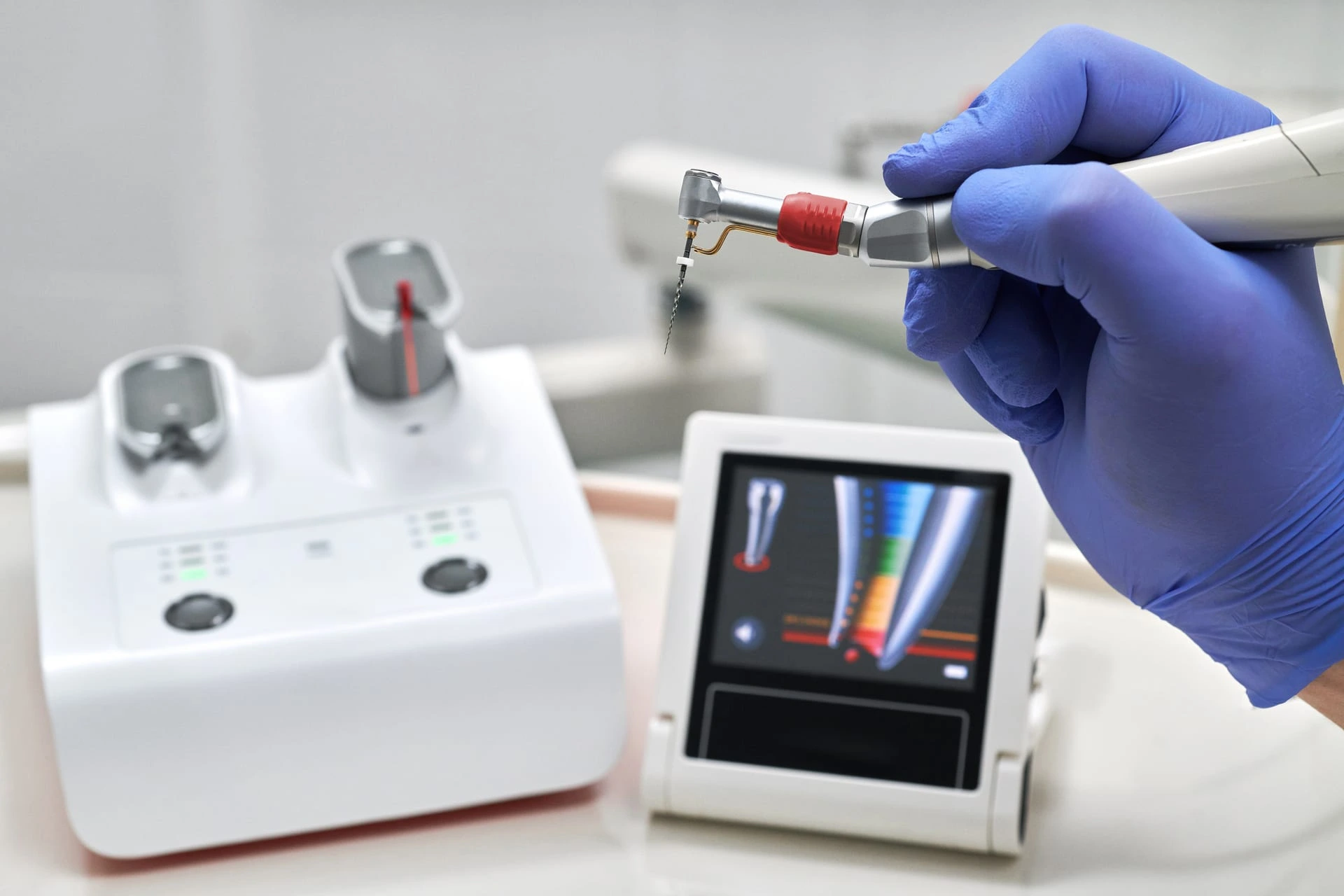
An apex locator is an electronic device designed to determine the position of the file tip within the root canal.
Rather than relying solely on radiographic interpretation, the device measures electrical properties within the canal system to identify the location of the apical constriction.
Modern apex locators have become an essential component of contemporary endodontic workflows.
How Apex Locators Work
Electronic apex locators measure impedance, resistance, or frequency-related electrical characteristics within the root canal.
As the file advances toward the apical region, the device continuously analyzes electrical changes and provides real-time feedback.
The clinician can monitor file position on the display and determine working length with greater precision.
Advantages of Apex Locators
Improved Measurement Accuracy
Modern apex locators generally provide highly accurate working length determination when used correctly.
This can help reduce the risk of over-instrumentation or under-preparation.
Reduced Dependence on Multiple Radiographs
Electronic measurements often reduce the need for repeated radiographic verification.
This may improve clinical efficiency while minimizing radiation exposure.
Real-Time Feedback
Unlike radiographs, apex locators provide immediate information during instrumentation.
Clinicians can continuously monitor file position throughout treatment.
Increased Efficiency
Many practitioners find that apex locators streamline workflow and reduce chair time.
This can improve productivity in busy clinical environments.
Better Support for Modern Endodontics
Electronic working length determination integrates effectively with:
– Rotary instrumentation
– Reciprocating systems
– Endodontic motors
– Digital treatment workflows
Limitations of Apex Locators
Although highly valuable, apex locators are not without limitations.
Technique Sensitivity
Accurate measurements depend on proper clinical technique and device usage.
Device Quality Matters
Performance can vary significantly among different products.
Build quality, calibration stability, and measurement algorithms all influence reliability.
Radiographs Are Still Necessary
Apex locators do not completely replace radiographic evaluation.
Radiographs remain essential for assessing:
– Canal anatomy
– Root curvature
– Periapical pathology
– Treatment planning
Most clinicians use apex locators and radiographs together rather than viewing them as competing technologies.
Comparison: Apex Locators vs Traditional Methods
| Feature | Traditiona | Radiographic Method | Apex Locator |
| Measurement Accuracy | Moderate | High |
| Real-Time Feedback | No | Yes |
| Radiation Exposure | Required | Reduced |
| Workflow Efficiency | Moderate | High |
| Anatomical Visualization | Excellent | Limited |
| Chairside Convenience | Moderate | High |
| Modern Endodontic Integration | Limited | Excellent |
Why Most Modern Clinics Use Both
A common misconception is that apex locators completely replace radiographs.
In reality, the most effective approach often combines both methods.
Radiographs Provide:
– Anatomical information
– Diagnostic support
– Treatment planning assistance
Apex Locators Provide:
– Real-time measurement
– Increased accuracy
– Workflow efficiency
Together, they create a more comprehensive and predictable treatment process.
–Considerations for Distributors and Buyers
For distributors and equipment buyers, apex locators remain a popular product category due to growing global demand for modern endodontic solutions.
When evaluating apex locator systems, important considerations include:
– Measurement accuracy
– Display readability
– Battery performance
– User interface
– Durability
– OEM opportunities
– Compatibility with endodontic workflows
Reliable apex locator products can become a valuable addition to a distributor’s endodontic portfolio.
The Future of Working Length Determination
As endodontic technology continues to evolve, apex locators are becoming increasingly integrated with other treatment systems.
Many modern endodontic motors now incorporate apex locator functionality, creating more efficient workflows and improving clinical convenience.
The trend toward digital endodontics is expected to further increase adoption of electronic measurement technologies worldwide.
Accurate working length determination remains fundamental to successful root canal treatment.
While traditional radiographic techniques continue to provide valuable diagnostic information, modern apex locators offer significant advantages in measurement accuracy, efficiency, and workflow integration.
Rather than replacing radiographs entirely, apex locators complement traditional methods and help clinicians achieve more predictable treatment outcomes.
For distributors and dental professionals alike, apex locators have become an important component of modern endodontic practice and a growing category within the dental equipment market.