High-Speed Dental Handpiece Guide: How to Choose the Right Configuration
A practical guide to high-speed dental handpiece configurations, covering RPM, torque heads, head size, water spray, LED and fiber optic illumination, connections, chuck types, and clinical applications.
High-Speed Dental Handpiece Guide: How to Choose the Right Configuration
Choosing a high-speed dental handpiece is not simply a matter of selecting the highest RPM or the most advanced-looking model.
Two high-speed handpieces can have similar rotational speeds but differ significantly in head size, torque characteristics, water spray, illumination, connection, chuck system, and overall configuration.
The key is to understand what each specification actually changes during clinical use.
A practical way to think about a high-speed dental handpiece is:
Specification → Clinical effect → Application → Appropriate configuration
This approach is more useful than treating specifications as a simple ranking from low to high.
For dentists, the goal is to match the handpiece to the procedures being performed. For distributors and importers, the goal is to build a product range with meaningful configuration differences rather than several models that look different but serve essentially the same purpose.
What Should You Compare in a High-Speed Dental Handpiece?
A high-speed dental handpiece can be evaluated across several independent configuration dimensions.
| Configuration | What it describes | What it mainly affects |
|---|---|---|
| RPM | Rotational speed | Cutting speed |
| Head size | Physical dimensions of the head | Access and visibility |
| Torque / head design | Cutting behavior under load | Performance when resistance is applied |
| Water spray | Number and arrangement of spray outlets | Cooling coverage |
| Illumination | LED, fiber optic or no integrated light | Working visibility |
| Connection | 2-hole, 4-hole, compatible coupling, etc. | Dental unit compatibility |
| Chuck | Push-button or wrench | Bur retention and workflow |
| Bearing | Bearing construction | Rotation, vibration, noise and durability |
| Weight and balance | Overall ergonomics | Handling and operator comfort |
These specifications should not be viewed as one-dimensional.
For example, a small-head handpiece can also have LED illumination. A torque-oriented handpiece can also have a multi-point spray system. A handpiece with 5-point spray can still use a 4-hole connection.
These specifications should not be viewed as one-dimensional. You can compare current high-speed dental handpiece configurations across different head, spray, illumination and connection options in our high-speed dental handpieces range.
In other words:
Head size, torque, spray, illumination and connection describe different aspects of the same handpiece.
This is why manufacturers can offer many models with similar RPM specifications but different clinical positioning.
1. High-Speed Dental Handpiece RPM: What Does Speed Actually Tell You?
RPM means revolutions per minute.
High-speed dental handpieces are designed to rotate at very high speeds for procedures such as tooth preparation, enamel reduction and crown preparation.
The AMEXORS high-speed handpiece range currently lists models in the approximately 300,000–450,000 RPM range, depending on the model.
However, RPM should not be evaluated by itself.
RPM affects cutting speed
Higher rotational speed allows the bur to make more cutting rotations per minute.
But clinical cutting performance is not determined by RPM alone.
It is also influenced by:
- Load applied to the bur
- Air pressure
- Turbine design
- Bur geometry
- Cutting material
- Water cooling
- Bearing and rotor condition
- Operator technique
Therefore:
A higher advertised RPM does not automatically mean better clinical performance.
Free-running speed vs working conditions
A specification sheet may provide a rotational speed measured under defined operating conditions.
Once the bur contacts the tooth, resistance is introduced.
This is where another parameter becomes important:
Torque.
RPM tells you how fast the rotor can rotate.
Torque-related characteristics help describe how the system behaves when resistance is applied.
This distinction is important when comparing high-speed handpieces.
For a deeper explanation of turbines, bearings, spindles and chuck mechanisms, see our guide to how a dental handpiece works.
2. Torque Head vs Standard Head: What Is the Difference?
One of the most misunderstood terms in high-speed dental handpieces is torque.
Torque should not be interpreted as simply meaning:
“Higher RPM.”
These are different concepts.
RPM describes speed
RPM answers:
How fast is the handpiece rotating?
Torque relates to rotational force
Torque describes rotational force available to overcome resistance.
During cutting, the bur encounters resistance from the tooth structure and the operator’s applied pressure.
A handpiece with a torque-oriented design is intended to maintain effective cutting behavior when resistance is applied.
The actual result depends on the turbine design, operating pressure, bur, load and other system factors.
Why does this matter clinically?
Consider two situations.
Light cutting load
The bur encounters relatively little resistance.
In this situation, rotational speed may be the more obvious characteristic.
Higher cutting resistance
The bur encounters greater resistance.
Maintaining useful cutting behavior under load becomes more important.
This is where torque-related characteristics become more relevant.
Therefore, the correct question is not:
“Which handpiece has the highest RPM?”
A better question is:
“How does the handpiece behave when the bur is actually cutting?”
Torque Head vs Standard Head
| Configuration | Main characteristic | When it may matter |
|---|---|---|
| Standard Head | General-purpose configuration | Routine restorative procedures |
| Torque-oriented Head | Designed with greater emphasis on cutting behavior under load | Procedures involving higher cutting resistance |
Neither configuration is universally better.
The appropriate choice depends on the clinical application and the design of the specific handpiece.
For an example of a torque-oriented configuration, see the Torque Head high-speed dental handpiece.
3. Small Head vs Standard Head: Why Does Head Size Matter?
Head size is one of the most visible differences between high-speed handpieces.
It directly affects the physical space occupied by the handpiece around the bur.
Standard Head
A standard-size head is generally intended for general-purpose clinical use.
It provides a familiar balance between:
- Access
- Cutting area
- Visibility
- Internal turbine space
- Overall handpiece geometry
For a general dental practice, a standard head can be a practical starting point when there is no specific access limitation.
Small or Mini Head
A small-head handpiece reduces the physical profile of the head.
The main advantage is not simply “smaller is better.”
The purpose is to improve access in areas where a larger head may obstruct the clinician’s view or make positioning more difficult.
Typical situations include:
- Pediatric dentistry
- Posterior teeth
- Restricted intraoral spaces
- Areas requiring a more compact working profile
- Procedures where visibility around the bur is particularly important
For example, the Mini Head high-speed dental handpiece specifies an ultra-mini head with a 10.4 mm diameter and 9.0 mm height, and positions the configuration for pediatric and restricted-access applications.
Small Head vs Standard Head
| Factor | Small Head | Standard Head |
|---|---|---|
| Physical profile | More compact | Larger |
| Restricted access | Strong advantage | More limited |
| Pediatric applications | Often useful | May be less suitable |
| Posterior access | Often useful | General-purpose |
| General dentistry | Suitable depending on preference | Common general-purpose option |
| Visibility around the head | Potentially improved | Depends on geometry |
The key principle is:
Choose head size according to access requirements, not because one size is inherently superior.
4. Small Head and Torque Are Not Opposite Choices
This is an important point when comparing high-speed handpieces.
Small Head and Torque describe different dimensions.
Small Head describes the physical geometry of the head.
Torque describes cutting behavior under resistance.
Therefore, a handpiece can theoretically combine:
Small Head + Torque-oriented design + LED + Multi-point Spray
Likewise, another handpiece may combine:
Standard Head + Torque-oriented design + LED + 3-point Spray
These are not contradictory configurations.
This explains why a dental handpiece catalog can contain many models with similar speeds but different configurations.
The manufacturer is not necessarily creating redundant products.
The models may be solving different clinical requirements.
5. Dental Handpiece Water Spray: Does More Spray Points Mean Better Cooling?
Water spray is one of the most commonly misunderstood high-speed handpiece specifications.
You may see:
- 1-point spray
- 2-point spray
- 3-point spray
- 4-point spray
- 5-point spray
It is tempting to treat these as a simple ranking.
That is not the correct way to evaluate them.
What does the number of spray points mean?
The number generally describes the arrangement or number of water outlets used to deliver coolant around the bur.
The objective is to provide effective cooling during high-speed cutting.
The basic design logic is:
More spray outlets → more opportunities to distribute coolant from different directions.
But:
More spray points ≠ automatically better cooling.
Actual cooling performance depends on more than outlet count.
Important factors include:
- Spray outlet position
- Spray direction
- Spray angle
- Water flow
- Water pressure
- Nozzle geometry
- Atomization
- Bur geometry
- Working angle of the handpiece
- Distance between the spray and cutting area
3-point vs 5-point spray
A 3-point spray system can already provide multi-directional cooling.
A 5-point system provides additional spray directions and can potentially distribute coolant more broadly.
For example, the T3S high-speed dental handpiece is specified with a 3-point water spray, while the S5LC uses a 5-way water spray.
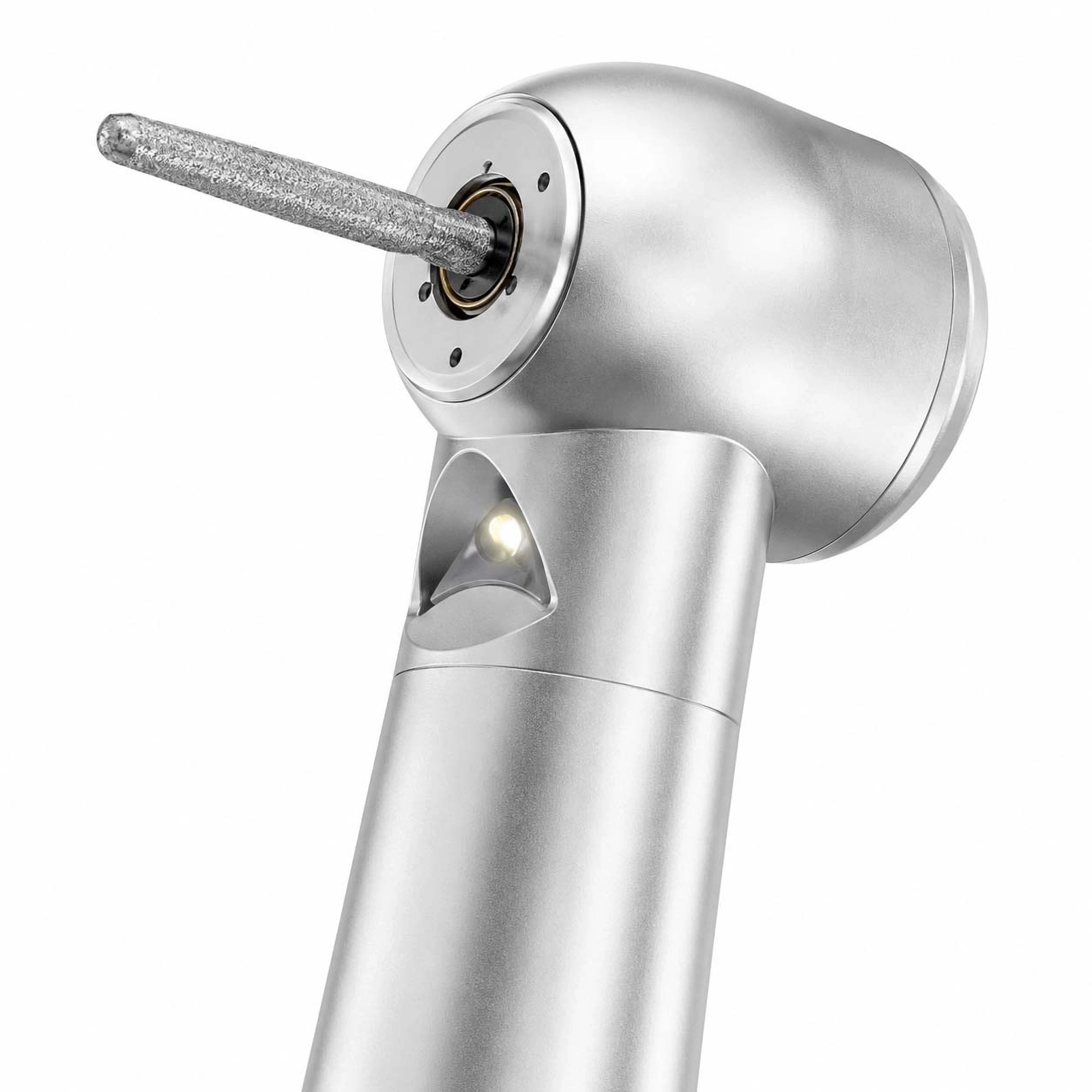
The S5LC high-speed dental handpiece, for example, combines 5-way water spray with integrated 5-LED illumination.
The correct comparison is therefore not:
“5-point is better than 3-point.”
Instead ask:
“Which spray design provides the appropriate cooling coverage for the intended clinical application?”
Practical comparison
| Spray configuration | General design concept | What to evaluate |
|---|---|---|
| 1-point | Single-direction delivery | Simplicity and actual coverage |
| 2-point | Two-direction delivery | Coverage around the bur |
| 3-point | Multi-direction delivery | Balanced cooling distribution |
| 4-point | Broader directional coverage | Nozzle arrangement and flow |
| 5-point | More distributed outlet arrangement | Actual coverage, flow and spray consistency |
For procurement, spray-point count should therefore be treated as one specification rather than a quality score.
6. LED vs Fiber Optic: Are They the Same Thing?
Another common source of confusion is illumination.
You may see:
- No light
- LED
- Fiber optic
- LED + fiber optic
These terms do not necessarily describe the same component.
LED
LED refers to the light-emitting source.
An LED handpiece can provide integrated illumination directly around the working area.
Fiber optic
Fiber optic refers to the optical transmission method used to deliver light.
A fiber-optic handpiece can use an external or integrated light source and transmit that light through an optical pathway toward the treatment area.
Therefore:
LED describes the light source. Fiber optic describes how light is transmitted.
A product may use both technologies.
No light
A non-illuminated handpiece relies on:
- Dental chair lighting
- Operatory lighting
- Headlights
- Ambient light
This can be adequate for routine applications, depending on the clinician and operating environment.
LED
Integrated LED illumination can improve visibility around the preparation site, particularly where the handpiece or oral anatomy creates shadows.
The AMEXORS S5LC, for example, uses a 5-LED ring illumination system, while the Mini Head model uses dual LED illumination.
Fiber optic
Fiber optic systems can be relevant when compatibility with a specific dental unit or coupling system is required.
For an example of a fiber-optic high-speed configuration, see the T4KFT / S4KFT fiber optic handpiece.
Therefore, when a customer asks:
“Do you have a fiber-optic handpiece?”
Do not immediately assume that they simply want “an LED handpiece.”
Confirm:
- What dental unit they use
- What coupling system they have
- Whether the unit provides the required light source
- Whether they require integrated LED generation or fiber-optic transmission
7. 2-Hole vs 4-Hole Dental Handpiece: What Does the Connection Mean?
The connection is a compatibility specification.
It should not be confused with water spray.
For example:
4-hole connection + 3-point spray
is perfectly possible.
Likewise:
2-hole connection + 5-point spray
can also exist depending on the product design.
These describe two completely different things.
Connection
The connection determines how the handpiece interfaces with the dental unit or coupling system.
Common configurations include:
- 2-hole
- 4-hole
- Quick coupling
- Other proprietary or system-specific connections
The AMEXORS high-speed range currently lists 2-hole and 4-hole options on several models, while the handpiece category also references quick-coupling systems.
Spray
Spray points describe the arrangement of water outlets.
For example:
4-hole connection + 5-point spray + LED
means:
- 4-hole = connection
- 5-point = water spray arrangement
- LED = illumination
These three specifications should never be treated as interchangeable.
8. Push-Button vs Wrench Chuck
The chuck is the mechanism used to retain the bur.
Two common approaches are:
Push-button chuck
and
Wrench-type chuck
Push-button chuck
A push-button system allows the operator to release and secure the bur by pressing the button.
Potential advantages include:
- Faster bur changes
- Easier clinical workflow
- Convenient daily operation
The AMEXORS high-speed products currently listed include push-button configurations, including the T3S, S5LC and Mini Head models.
Wrench chuck
A wrench-type system uses a tool to tighten or release the bur.
Its suitability depends on the product design, operator preference and market requirements.
The important point is that chuck type is a workflow and retention-system consideration, not a substitute for evaluating the turbine itself.
9. How These Specifications Work Together
This is where high-speed handpiece selection becomes more useful.
A specification should not be evaluated in isolation.
Consider this configuration:
Small Head + LED + 5-Point Spray + Push Button + 4-Hole
Each element solves a different problem.
| Configuration | Main purpose |
|---|---|
| Small Head | Access |
| LED | Visibility |
| 5-Point Spray | Cooling distribution |
| Push Button | Bur-change workflow |
| 4-Hole | Dental unit compatibility |
Another configuration might be:
Standard Head + Torque-oriented Design + LED + 3-Point Spray + 4-Hole
This configuration puts more emphasis on:
- General access
- Cutting behavior under load
- Illumination
- Cooling
- Compatibility
Neither configuration is automatically better.
They are simply designed around different priorities.
This is the key to understanding why there are so many high-speed dental handpieces in the market.
10. High-Speed Dental Handpiece Selection Matrix
Instead of asking which configuration has the most specifications, start with the clinical requirement.
| Main requirement | Configuration to consider | Why |
|---|---|---|
| General restorative procedures | Standard Head | General-purpose access |
| Restricted posterior access | Small / Mini Head | More compact working geometry |
| Pediatric applications | Small / Mini Head | Better suited to smaller oral spaces |
| Higher cutting resistance | Torque-oriented design | Greater emphasis on load-related cutting behavior |
| Improved working visibility | LED or compatible fiber optic | Integrated illumination |
| Broader spray distribution | Multi-point spray | More directional spray outlets |
| Fast bur changes | Push Button | Simplified bur replacement |
| Existing 2-hole unit | 2-Hole connection | Compatibility |
| Existing 4-hole unit | 4-Hole connection | Compatibility |
| Product-line differentiation | Different configuration combinations | Creates meaningful model positioning |
This table should be used as a starting point rather than a universal prescription.
Actual selection still depends on the specific handpiece design and clinical requirements.
11. Four Practical High-Speed Handpiece Selection Examples
Example 1: General Dental Practice
A dentist mainly performs:
- General restorative procedures
- Tooth preparation
- Routine crown preparation
The clinic already uses a 4-hole dental unit and wants integrated illumination.
A reasonable starting configuration would be:
Standard Head + LED + Multi-point Spray + Push Button + 4-Hole
The priority is balanced daily usability rather than maximizing one specification.
Example 2: Pediatric or Restricted-Access Dentistry
The main problem is not speed.
The clinician needs better access in a smaller oral space.
A more relevant configuration would be:
Small / Mini Head + LED + Appropriate Spray + Compatible Connection
The smaller head is the primary selection factor because access and visibility are the actual problems being solved.
The AMEXORS Mini Head model is specifically positioned around pediatric and narrow-cavity applications.
Example 3: Procedures With Greater Cutting Resistance
A clinician regularly performs procedures where cutting resistance is an important consideration.
Instead of simply searching for the highest RPM, the buyer should evaluate:
Torque-oriented head design + appropriate spray + illumination + compatible connection
The key question is how the handpiece behaves under working load, not simply its free-running speed.
Example 4: Distributor Building a Three-Level Range
A distributor does not necessarily need ten similar high-speed handpieces.
A clearer product structure could be:
Entry / General
Standard Head
Basic illumination or no light
Standard spray configuration
Standard connection
Mainstream
Standard Head
LED
3-point or multi-point spray
Push Button
2-hole / 4-hole options
Enhanced
Torque-oriented configuration
LED or fiber-optic system
Multi-point spray
Push Button
Additional hygiene or filtration features where applicable
The purpose is not to make the most expensive model automatically appear “best.”
The purpose is to create clear differences between models so that each product has a reason to exist in the distributor’s portfolio.
12. How Should Distributors Build a High-Speed Handpiece Range?
For distributors and importers, product selection is slightly different from selecting one handpiece for a clinic.
The question becomes:
How can different models serve different customer requirements without creating unnecessary SKU overlap?
A useful approach is to organize the range by configuration purpose.
General-Purpose Model
Target:
- General dental practices
- Routine restorative procedures
- Price-sensitive markets
Core configuration:
Standard Head + Standard Spray + Compatible Connection
Mainstream Illuminated Model
Target:
- General practices
- Clinics upgrading existing equipment
- Mid-range distribution programs
Core configuration:
Standard Head + LED + Multi-point Spray + Push Button
Performance-Focused Model
Target:
- Clinicians requiring stronger cutting behavior under resistance
- Higher-end positioning
Core configuration:
Torque-oriented Head + LED/Fiber Optic + Multi-point Spray
Compact Model
Target:
- Pediatric dentistry
- Posterior access
- Narrow operating areas
Core configuration:
Small / Mini Head + Illumination + Appropriate Spray
The advantage of this approach is that the distributor can explain why each model exists.
That is more commercially useful than simply offering several handpieces with almost identical specifications.
For a broader view of the dental handpiece range, including high-speed, low-speed and contra-angle options, see our dental handpieces category.
13. How to Compare Two High-Speed Dental Handpieces With Similar Specifications
Suppose two products both claim:
- 400,000+ RPM
- Ceramic bearings
- LED
- Push-button chuck
- 4-hole connection
At first glance, they look almost identical.
Instead of stopping at the specification sheet, compare the actual configuration and intended use.
If two handpieces still appear similar after comparing their configurations, see our Dental Handpiece Quality Guide for factors beyond the specification sheet.
Ask:
1. What head design does each model use?
Standard or compact?
2. What happens under load?
Is one model designed around a torque-oriented head or different turbine geometry?
3. How is water delivered?
3-point, 4-point or 5-point?
More importantly, how are the outlets positioned?
4. How is illumination delivered?
Integrated LED?
Fiber optic?
What coupling or dental unit does it require?
5. What chuck system is used?
Push button or wrench?
6. What is the actual connection?
2-hole, 4-hole or a compatible coupling system?
7. What clinical problem is the configuration designed to solve?
This final question is often more useful than comparing a long list of specifications.
14. What Should You Ask a Customer Before Recommending a High-Speed Handpiece?
For a dentist or clinic, you do not need to ask twenty technical questions immediately.
Start with the highest-value questions.
Question 1
What procedures will the handpiece mainly be used for?
This establishes the clinical application.
Question 2
Do you need a compact head for restricted access, or is a standard head suitable?
This establishes head geometry.
Question 3
Do you require integrated illumination?
This establishes the light requirement.
Question 4
What connection does your dental unit use?
This prevents compatibility problems.
For distributors, add:
Question 5
What market segment or target price level are you positioning the handpiece for?
Then you can recommend a configuration rather than simply sending a catalog.
For example:
Based on your application, I would suggest a Standard Head + LED + 3-point spray configuration for the main product line, and a Mini Head + LED configuration as a specialized option for pediatric or restricted-access applications.
That is more useful than asking the buyer to choose between ten models themselves.
15. High-Speed Dental Handpiece Selection Checklist
Before selecting or sourcing a high-speed dental handpiece, confirm:
Clinical Application
- What procedures will it perform?
- General restorative work?
- Crown preparation?
- Pediatric dentistry?
- Posterior access?
- Higher-resistance cutting?
Head Configuration
- Standard Head?
- Small / Mini Head?
- Torque-oriented design?
Speed and Cutting
- What RPM is specified?
- Under what operating conditions?
- How does the handpiece behave under load?
- Is the RPM being compared together with torque-related characteristics?
Cooling
- What spray configuration is used?
- Where are the spray outlets positioned?
- Is water coverage consistent around the bur?
- What are the actual water-flow requirements?
Illumination
- No light?
- LED?
- Fiber optic?
- Is the illumination system compatible with the dental unit?
Connection
- 2-hole?
- 4-hole?
- Quick coupling?
- Other system-specific connection?
Chuck
- Push button?
- Wrench?
Product Range
For distributors:
- Does the configuration have a clear market position?
- Does it overlap too heavily with existing models?
- Can the model serve a specific customer segment?
- Can the configuration be differentiated through OEM or private-label requirements?
16. The Key Principle: Choose the Configuration, Not the Highest Specification
The most useful way to evaluate a high-speed dental handpiece is to stop thinking of specifications as a ranking.
A handpiece with:
450,000 RPM + 5-point spray + LED
is not automatically the right choice for every dentist.
A handpiece with:
300,000 RPM + Mini Head + LED
may be more appropriate when access is the main problem.
Likewise, a:
Standard Head + Torque-oriented Design + LED
may make more sense when cutting behavior under resistance is the primary consideration.
The correct question is therefore:
What clinical problem does this configuration solve?
If the decision is between high-speed and low-speed systems rather than between high-speed configurations, see our guide to High-Speed vs Low-Speed Dental Handpieces.
That question connects the specification to actual use.
17. How AMEXORS Approaches High-Speed Dental Handpiece Selection
AMEXORS currently offers a high-speed handpiece range covering different configuration directions, including Mini Head, torque-oriented designs, 3-point and 5-point spray systems, LED illumination and fiber-optic configurations.
For example, the T3S is listed with a 300,000–450,000 RPM range, ceramic bearings, push-button chuck, 3-point water spray and optional 2-hole / 4-hole connections.
The S5LC is listed with 300,000–450,000 RPM, ceramic bearings, push-button chuck, 5-way water spray and a 5-LED ring illumination system.
The Mini Head model uses a compact head geometry with dual LED illumination and 2-hole / 4-hole connection options, providing an example of how head size can be treated as a separate configuration dimension.
This configuration-based approach is useful for both clinical buyers and distributors because the objective is not simply to offer more specifications.
It is to match different configurations to different applications and market requirements.
Conclusion
A high-speed dental handpiece is not defined by RPM alone.
The most important specifications should be understood as different parts of one configuration:
- RPM affects rotational speed.
- Torque-related design affects cutting behavior under resistance.
- Head size affects access and visibility.
- Water spray affects how coolant is distributed around the cutting area.
- LED and fiber optics relate to illumination in different ways.
- Connection type determines compatibility with the dental unit.
- Chuck type affects bur retention and workflow.
- Bearing and internal design contribute to the overall operating characteristics of the handpiece.
The best configuration is therefore not necessarily the one with the highest number, the most spray points, or the most expensive specification.
It is the configuration that solves the actual clinical or procurement requirement.
For clinics, start with the procedures and working environment.
For distributors, start with customer segments and meaningful product differentiation.
For OEM and private-label buyers, define the target application and market position first, then build the configuration around those requirements.
When comparing high-speed dental handpieces, think in this sequence:
Application → Head → Cutting behavior → Cooling → Illumination → Connection → Chuck → Product positioning
That approach turns a long specification sheet into a practical product-selection framework.