High Speed vs Low Speed Dental Handpieces
Learn the key differences between high-speed and low-speed dental handpieces, including RPM, torque, cooling, bur compatibility, clinical applications, maintenance, and buying considerations for dental clinics and distributors.

High-Speed vs Low-Speed Dental Handpieces Differences: RPM, Applications & Buying Guide
High-speed and low-speed dental handpieces are designed for different stages of dental treatment. High-speed handpieces are primarily used for rapid cutting and tooth preparation, while low-speed handpieces provide greater control for finishing, polishing, caries removal, prophylaxis, and selected endodontic procedures.
The difference is not simply rotational speed. RPM, torque, cooling, bur compatibility, drive mechanism, handling, and clinical application all affect how a dental handpiece performs.
For dental professionals, distributors, and dental equipment buyers, understanding these differences is important when selecting the right dental handpiece for a specific procedure or building a complete dental handpiece portfolio.
High-Speed vs Low-Speed Dental Handpieces at a Glance
| Feature | High-Speed Dental Handpiece | Low-Speed Dental Handpiece |
|---|---|---|
| Primary Function | Rapid cutting and tooth preparation | Finishing, polishing, and controlled procedures |
| Typical Speed | Commonly around 300,000–450,000 rpm for high-speed air turbines | Commonly around 5,000–40,000 rpm depending on the motor and attachment |
| Torque Characteristics | Lower torque at very high rotational speed | Higher torque and greater control at lower speed |
| Drive System | Commonly air turbine; electric high-speed systems are also available | Air-driven or electric micromotor with compatible attachment |
| Cooling | Water spray is commonly used during cutting | Cooling requirements depend on the procedure and system |
| Common Bur Type | Friction-grip (FG) burs | RA/latch-type or other compatible burs depending on the attachment |
| Typical Applications | Crown preparation, cavity preparation, tooth reduction and sectioning | Polishing, finishing, prophylaxis, caries removal and selected endodontic procedures |
| Handling | Optimized for rapid cutting | Optimized for controlled operation |
Actual speed ranges vary by handpiece design, motor, attachment, gear ratio, and manufacturer specifications. Buyers should always evaluate the complete system rather than comparing RPM alone.
Internal Components and Design
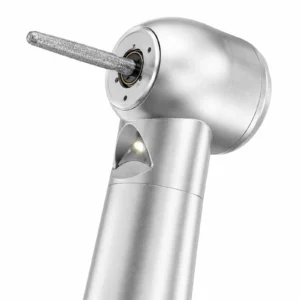
The head of a high-speed handpiece contains several critical components:
Air turbine mechanism
Ball bearings (stainless steel or ceramic bearings)
Chuck system (typically push-button)
Water spray system for cooling
Optional fiber optic lighting system
Low-speed handpieces feature different internal architectures:
Electric micromotor or air-driven rotary vane motor
Internal gear systems
Attachment systems for various heads
Chuck mechanism for bur retention
The design of these components significantly influences handpiece performance, particularly in terms of concentricity—the ability of the bur to rotate perfectly along its central axis. When a handpiece operates with poor concentricity, it causes excessive vibration, irregular cutting, and reduced control during procedures.
What Is a High-Speed Dental Handpiece?
A high-speed dental handpiece is designed to rotate a dental bur at very high speed, allowing clinicians to remove tooth structure and restorative materials efficiently.
High-speed handpieces are commonly associated with air turbine systems. Compressed air drives a turbine rotor inside the handpiece head, producing very high rotational speed.
Many professional high-speed handpieces operate in the range of approximately 300,000–450,000 rpm, although the actual operating range depends on the specific model and drive system.
The main advantage of a high-speed dental handpiece is cutting efficiency. Instead of applying substantial pressure, the clinician can use a suitable bur at high rotational speed to remove hard dental tissues efficiently.
High-Speed Dental Handpiece RPM
RPM, or revolutions per minute, is one of the most commonly discussed specifications when comparing dental handpieces.
High-speed dental handpieces can operate at several hundred thousand revolutions per minute. For example, high-speed air turbine handpieces commonly operate around 300,000–450,000 rpm, depending on the model.
However, higher RPM does not automatically mean greater torque or greater overall performance.
A high-speed handpiece is designed around rapid rotation and efficient cutting. When significant resistance is applied, an air turbine can lose rotational speed under load. This is one reason clinicians generally use appropriate burs and controlled pressure rather than forcing the handpiece through the material.
Therefore:
High RPM should not be interpreted as high torque.
When evaluating a high-speed dental handpiece, RPM should be considered together with cutting efficiency, cartridge quality, bearing performance, concentricity, chuck stability, spray performance, and ergonomics.
How Does a High-Speed Dental Handpiece Work?
In an air turbine system, compressed air enters the handpiece and rotates a small turbine inside the head.
The basic operating principle is:
Compressed air → turbine rotation → bur rotation → cutting
Because the bur rotates at extremely high speed, friction between the bur and tooth structure can generate heat. Water spray is therefore commonly used during high-speed cutting to control temperature.
The performance of the turbine cartridge, ceramic bearings, chuck, and bur all influence the final cutting experience.
A high-quality cartridge should provide stable rotation, low vibration, and good concentricity. Poor concentricity can cause bur wobble, vibration, irregular cutting, and reduced operator control.
What Is a High-Speed Dental Handpiece Used For in Dentistry?
High-speed dental handpieces are primarily used for procedures requiring rapid removal or reduction of hard dental tissues.
Common applications include:
- Cavity preparation
- Crown preparation
- Tooth preparation
- Enamel reduction
- Dentin cutting
- Removal of existing restorations
- Sectioning tooth structure
- Access preparation
- Adjustment of restorative materials
High-speed handpieces are particularly useful when cutting efficiency is more important than high torque at low speed. For buyers comparing different high-speed dental handpieces, factors such as cartridge quality, spray performance, connection type, and bur compatibility should also be considered.
Why Does a High-Speed Dental Handpiece Need Water Spray?
High-speed cutting creates friction between the bur and the material being removed. Without adequate cooling, heat can build up during operation.
Water spray helps control the temperature at the cutting site and supports safer clinical operation.
For this reason, water spray performance is an important specification when selecting a high-speed dental handpiece.
When comparing different models, buyers should consider:
- Number of spray ports
- Spray distribution
- Water flow consistency
- Spray direction
- Head design
- Visibility during treatment
A handpiece with a high nominal RPM but poor spray performance may not provide the best overall clinical experience.
What Is a Low-Speed Dental Handpiece?
A low-speed dental handpiece operates at substantially lower rotational speeds than a high-speed handpiece and is designed for greater control and torque at lower speeds.
Low-speed systems can be air-driven or electric and are commonly used with different attachments, including contra-angle and straight handpieces.
Depending on the motor, attachment, and gear ratio, low-speed systems can cover a broad range of applications.
Typical low-speed systems operate within approximately 5,000–40,000 rpm, although specialized systems may operate outside this range.
The lower rotational speed makes these handpieces suitable for procedures where controlled material removal, finishing, polishing, or tactile feedback is more important than maximum cutting speed.
Low-Speed Dental Handpiece RPM
When searching for information about low-speed handpiece RPM, it is important to distinguish between the speed of the motor and the output speed of the attached handpiece.
A low-speed system may combine:
- An air motor or electric micromotor
- A straight handpiece
- A contra-angle handpiece
- A reduction or increase gear ratio
- A specialized attachment
As a result, the final bur speed depends on the complete configuration.
For general low-speed applications, approximately 5,000–40,000 rpm is a useful reference range, but buyers should always check the manufacturer’s specified output speed for the exact configuration.
Types of Low-Speed Dental Handpieces
Low-speed systems are available in several configurations.
Contra-Angle Handpieces
Contra-angle handpieces are widely used for controlled restorative, polishing, prophylaxis, and other procedures where the angled head provides better access.
Different gear ratios can be used to change the output speed and torque characteristics.
Straight Handpieces
Straight handpieces provide a different handling configuration and are commonly used for specific laboratory, polishing, surgical, or clinical applications depending on the model.
Air-Driven Low-Speed Systems
Air motors can provide a practical solution for clinics that already use an air-driven dental unit.
Electric Low-Speed Systems
Electric micromotors can provide more consistent speed and torque control, depending on the motor and control unit.
What Is a Low-Speed Dental Handpiece Used For in Dentistry?
Low-speed dental handpieces are commonly used for:
- Polishing
- Finishing restorations
- Contouring
- Prophylaxis
- Caries removal
- Adjusting restorative materials
- Selected endodontic procedures
- Controlled cutting and finishing applications
The exact application depends on the attachment, bur, speed, torque, and clinical procedure.
Key Differences Between High-Speed and Low-Speed Dental Handpieces:
The most important differences involve more than RPM.
Speed and RPM
High-speed handpieces prioritize very high rotational speed for rapid cutting.
Low-speed systems operate at substantially lower speeds and are designed to provide more controlled movement.
This creates a fundamental difference:
High speed prioritizes cutting efficiency.
Low speed prioritizes control and torque.
However, speed should never be evaluated in isolation. The appropriate RPM depends on the bur, material, procedure, torque, cooling, and handpiece design.
Torque
Torque is the rotational force available when the bur encounters resistance.
High-speed air turbines achieve their performance primarily through very high rotational speed, but their torque characteristics differ from those of low-speed electric systems.
Low-speed systems generally provide greater torque at lower output speeds, making them useful when the bur encounters more resistance or when controlled material removal is required.
This is why:
High RPM does not necessarily mean high torque.
A handpiece with lower RPM can provide more usable force under load depending on the motor and gear configuration.
Cutting Efficiency
High-speed handpieces are generally preferred when rapid cutting of enamel, dentin, or restorative materials is required.
Low-speed handpieces are more suitable when the clinician needs greater control over the rate and depth of material removal.
The better choice therefore depends on the procedure rather than on which handpiece has the higher RPM.
Heat Generation and Cooling
High-speed cutting can generate significant heat because of the very high rotational speed and friction between the bur and tooth structure.
Water spray is therefore commonly used with high-speed handpieces.
Low-speed procedures can generate less heat depending on the bur, pressure, material, speed, and duration of contact. However, lower speed does not mean that cooling is never required.
Cooling requirements should always be determined according to the clinical procedure and manufacturer recommendations.
Bur Compatibility
Bur compatibility is another important difference.
High-speed turbines commonly use friction-grip, or FG, burs.
Low-speed systems commonly use compatible RA/latch-type burs or other bur configurations depending on the attachment.
The bur shank, chuck mechanism, handpiece head, and intended application must all be compatible.
Using an incompatible bur can cause poor retention, vibration, runout, or damage to the chuck.
For distributors and importers, bur compatibility should therefore be confirmed before placing a bulk order.
Noise and Vibration
Air turbine high-speed handpieces are generally associated with a higher-pitched operating sound than many low-speed systems.
Noise and vibration are influenced by several factors, including:
- Turbine design
- Bearing quality
- Cartridge condition
- Bur balance
- Concentricity
- Air pressure
- Manufacturing tolerances
A high-speed handpiece should therefore not be evaluated only by its maximum RPM.
Stable rotation and low vibration are equally important for clinical handling.
Control and Handling
High-speed handpieces are optimized for efficient cutting and preparation.
Low-speed systems provide greater control for procedures requiring slower and more deliberate movement.
For this reason, clinicians often use both types of handpieces during a complete treatment workflow rather than treating one as a replacement for the other.
High-Speed vs Low-Speed Dental Handpiece: Clinical Applications
The right handpiece depends heavily on the procedure.
| Dental Procedure | Commonly Preferred Handpiece | Main Reason |
| Crown preparation | High-speed | Rapid tooth reduction |
| Cavity preparation | High-speed | Efficient cutting |
| Enamel reduction | High-speed | High cutting efficiency |
| Removal of old restorations | High-speed | Rapid material removal |
| Tooth sectioning | High-speed | Efficient cutting |
| Finishing restoration margins | Low-speed | Better control |
| Polishing restorations | Low-speed | Controlled surface finishing |
| Prophylaxis | Low-speed | Compatible prophy attachments |
| Caries removal | Depends on procedure | Control and tissue preservation |
| Endodontic procedures | Specialized low-speed/endo system | Controlled instrument movement |
The table should be treated as a general guide rather than a universal clinical protocol. Specific procedures may require different instruments depending on the clinician, material, bur, and treatment system.
High-Speed Handpiece for Crown Preparation
High-speed handpieces are commonly used during crown preparation because they can remove tooth structure rapidly and efficiently.
The combination of high rotational speed, appropriate diamond burs, and water spray makes them suitable for reducing enamel and dentin during preparation.
High-Speed Handpiece for Cavity Preparation
High-speed handpieces are also widely used for cavity preparation and rapid removal of tooth structure.
The exact bur and operating technique should be selected according to the clinical procedure and material.
Low-Speed Handpiece for Polishing
Polishing is one of the most common applications for low-speed systems.
The lower speed and controlled operation make it easier to work with polishing cups, discs, brushes, and other compatible attachments.
Low-Speed Handpiece for Finishing
After major material removal, a low-speed handpiece can provide greater control during finishing and adjustment.
This is particularly useful when the clinician needs to remove small amounts of material rather than perform aggressive cutting.
Low-Speed Handpiece for Endodontic Procedures
Certain endodontic procedures use low-speed or specialized endodontic handpiece systems because controlled rotational movement is important.
However, not every low-speed handpiece is suitable for endodontic applications.
Clinicians should select an appropriate endodontic system, compatible file, speed, torque setting, and attachment according to the intended procedure and manufacturer’s instructions.
How to Choose Between a High-Speed and Low-Speed Dental Handpiece
There is no single handpiece that is best for every dental procedure.
Instead, consider the intended application first.
For Dental Clinics
A clinic should consider:
- Which procedures are performed most frequently?
- What speed range is required?
- Is water spray required?
- Which bur system is already being used?
- What connection is available on the dental unit?
- How important are noise and vibration?
- How frequently will the handpiece be sterilized?
- What replacement parts and service support are available?
For many clinics, a combination of high-speed and low-speed handpieces provides better coverage than relying on one type.
For Dental Distributors
Distributors need to consider more than clinical performance.
A handpiece portfolio should also be evaluated according to:
- Product consistency
- Bearing and cartridge quality
- Chuck reliability
- Spray performance
- Connection compatibility
- Spare parts availability
- Packaging
- Warranty policy
- Technical support
- MOQ
- Lead time
- OEM capability
- Private-label requirements
A handpiece that performs well in a sample but is inconsistent across production batches can create significant after-sales problems for distributors.
For distributors building a long-term product portfolio, choosing a reliable dental handpiece supplier is also important for maintaining product consistency and reducing after-sales risk.
What Should You Look for When Buying Dental Handpieces?
For professional buyers, several components deserve particular attention.
Bearing and Cartridge Quality
The cartridge is one of the most important components of a high-speed handpiece.
Bearing quality can influence:
- Noise
- Vibration
- Rotational stability
- Service life
- Cutting consistency
When configuring a high-speed handpiece, we highly recommend opting for ceramic ball bearings. Compared to traditional stainless steel bearings, ceramic bearings are lighter, harder, and generate significantly less heat and friction, resulting in lower noise levels and a much longer service life. For a deeper technical dive, read our complete comparison on Ceramic Bearings vs Steel Bearings.
Chuck System
The chuck secures the bur inside the handpiece.
Common systems include push-button mechanisms and other retention designs.
A good chuck should provide secure bur retention while allowing efficient bur replacement.
Buyers should check:
- Bur retention
- Push-button performance
- Chuck durability
- Concentricity
- Compatibility with the intended bur
Water Spray Performance
Water spray is an important performance factor for high-speed handpieces.
When comparing products, evaluate the spray pattern rather than simply counting the number of ports.
A well-designed spray system should provide consistent cooling while maintaining adequate visibility of the operating area.
LED and Fiber Optic Options
Lighting can improve visibility during clinical procedures.
Depending on the product configuration, buyers may encounter:
- LED handpieces
- Fiber optic handpieces
- Integrated lighting systems
For distributors, LED and fiber optic options can also be useful when developing different product tiers within a portfolio.
Connection Compatibility
A handpiece must be compatible with the dental unit, hose, motor, or coupling system being used.
Before purchasing, confirm:
- Connection type
- Number of holes
- Coupling compatibility
- Air pressure requirements
- Water supply
- Electrical requirements where applicable
For international distributors, connection compatibility is especially important because different markets may use different equipment configurations.
Sterilization Compatibility
Dental handpieces are repeatedly exposed to cleaning, disinfection, and sterilization processes.
Therefore, buyers should confirm the manufacturer’s sterilization instructions and the number of cycles the product is designed to withstand.
For professional products, sterilization compatibility should be evaluated together with material selection, seals, bearings, chuck components, and overall construction.
Spare Parts and Serviceability
A dental handpiece is not only a finished product.
For distributors, long-term product support can be equally important.
Before placing a larger order, ask about:
- Replacement cartridges
- Bearings
- O-rings
- Chuck components
- Couplings
- Repair procedures
- Spare parts availability
- Warranty handling
- Technical support
Reliable spare-part support can significantly reduce after-sales risk.
High-Speed vs Low-Speed Dental Handpiece: Frequently Asked Questions
What is the difference between a high-speed and low-speed dental handpiece?
The main differences are rotational speed, torque characteristics, cooling requirements, bur compatibility, and clinical applications. High-speed handpieces are primarily designed for rapid cutting and preparation, while low-speed systems provide greater control for finishing, polishing, prophylaxis, and selected procedures.
What RPM is a high-speed dental handpiece?
High-speed dental handpieces commonly operate at several hundred thousand RPM. Many air turbine models operate around 300,000–450,000 rpm, although the exact range depends on the specific product and manufacturer.
What RPM is a low-speed dental handpiece?
Low-speed dental handpieces commonly operate within approximately 5,000–40,000 rpm, although the actual output speed depends on the motor, attachment, and gear ratio.
Is a high-speed dental handpiece better than a low-speed handpiece?
Neither is universally better. High-speed handpieces are better suited to rapid cutting and tooth preparation, while low-speed handpieces are generally better suited to controlled finishing, polishing, and other procedures requiring lower speed and greater torque.
What is a high-speed dental handpiece used for?
Common applications include cavity preparation, crown preparation, tooth reduction, enamel and dentin cutting, removal of existing restorations, and other procedures requiring efficient hard-tissue removal.
What is a low-speed dental handpiece used for?
Common applications include polishing, finishing, prophylaxis, controlled caries removal, restoration adjustment, and selected endodontic procedures.
Do high-speed dental handpieces require water spray?
Water spray is commonly used during high-speed cutting to control heat generated by friction. The exact cooling configuration depends on the handpiece and clinical application.
What type of bur is used with a high-speed dental handpiece?
High-speed dental handpieces commonly use friction-grip (FG) burs. Buyers should confirm the correct bur specification for the particular handpiece and chuck system.
What type of bur is used with a low-speed dental handpiece?
Low-speed systems commonly use RA/latch-type burs or other compatible burs depending on the attachment. The correct bur should always match the handpiece and intended procedure.
What should distributors consider when buying dental handpieces?
Distributors should evaluate clinical performance as well as product consistency, cartridge and bearing quality, chuck reliability, spray performance, connection compatibility, sterilization, spare parts, warranty, MOQ, lead time, packaging, and OEM/private-label capabilities.
Can one dental handpiece replace both high-speed and low-speed handpieces?
Generally, no. High-speed and low-speed systems are designed for different performance requirements. A clinic that performs a wide range of procedures will often benefit from having both systems available.
Conclusion
High-speed and low-speed dental handpieces are complementary instruments rather than competing products.
High-speed handpieces prioritize rapid cutting and tooth preparation through very high rotational speed, while low-speed systems provide controlled operation and greater torque characteristics for finishing, polishing, prophylaxis, and other applications.
For dental professionals, the correct choice depends on the procedure, bur, required speed, torque, cooling, and handling requirements.
For distributors and dental equipment buyers, the decision should go further. Bearing and cartridge quality, chuck reliability, spray performance, connection compatibility, sterilization, spare parts, production consistency, and supplier support can all affect the long-term value of a dental handpiece.
The best dental handpiece is therefore not simply the one with the highest RPM. It is the handpiece whose mechanical design, clinical application, configuration, and supply support match the requirements of the user and the market.
- High-Speed vs Low-Speed Dental Handpieces at a Glance
- What Is a High-Speed Dental Handpiece?
- How Does a High-Speed Dental Handpiece Work?
- What Is a High-Speed Dental Handpiece Used For?
- Why Does a High-Speed Dental Handpiece Need Water Spray?
- What Is a Low-Speed Dental Handpiece?
- Types of Low-Speed Dental Handpieces
- What Is a Low-Speed Dental Handpiece Used For?
- High-Speed vs Low-Speed Dental Handpiece: Key Differences
- High-Speed vs Low-Speed Dental Handpiece: Clinical Applications
- How to Choose Between a High-Speed and Low-Speed Dental Handpiece
- What Should You Look for When Buying Dental Handpieces?
- High-Speed vs Low-Speed Dental Handpiece: Frequently Asked Questions
- Conclusion